Some decisions strike like a thunderclap.
And others, behind their apparent brutality, reveal months of ignored weak signals.
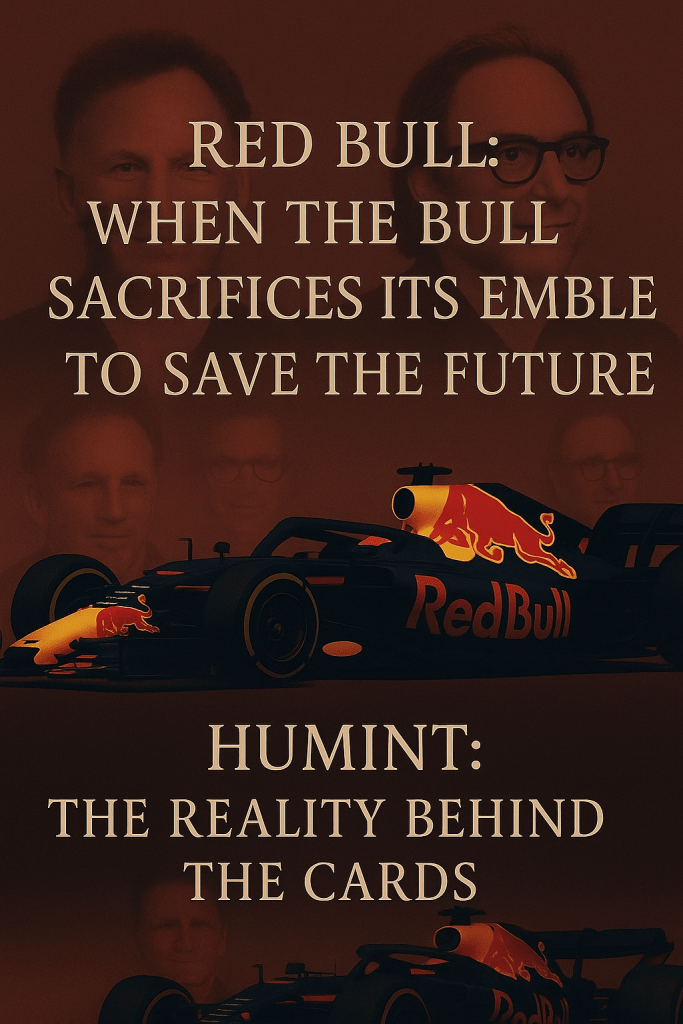
Christian Horner’s departure, after 20 years at the helm of Red Bull Racing, falls into this second category.
Because while the surface shows a man with an exceptional track record – 8 drivers’ titles, 6 constructors’ titles, a team turned into a war machine – the hidden side tells of an invisible erosion, far deeper than a simple lack of results.
Let’s start with the visible scenery.
2025, a lackluster season:
Red Bull, used to dominating, drops to 4th place in the constructors’ standings. McLaren and Mercedes regain the upper hand. Key engineers – led by Adrian Newey – leave, tired of internal tensions. The Verstappen camp whispers behind the scenes that a release clause for 2026 does indeed exist.
Facts. Tangible. Measurable.
But in every crisis, there is the invisible – where the HUMINT eye lingers.
⸻
1. The weight of crumbling alliances
Christian Horner was a charismatic strategist, but his power rested on a delicate balance: the trust of Helmut Marko, the support of Dietrich Mateschitz (Red Bull’s founder), and the loyalty of an exceptional technical circle.
With Mateschitz’s passing in 2022, the equation changed. The new Austrian decision-makers see the team less as a personal stronghold and more as a corporate asset.
HUMINT translation: Horner loses his historic shield. Every misstep becomes an open file.
⸻
2. Scandals that leave marks
Cleared in 2024 after internal allegations of “misconduct,” he nonetheless remained tainted. Even when innocence is acknowledged, the shadow of suspicion lingers in the collective imagination. This weakens alliances, fuels rivalries, and gives ammunition to those pushing for change.
HUMINT translation: a man “cleared” but never fully unscathed, which undermines his levers of influence.
⸻
3. The strategic fault line: 2026
The 2026 engine regulations mark a total rupture. They require long-term vision, the ability to rebuild a united technical team, and to convince Verstappen to stay. Yet, Horner is seen as a leader of the past, attached to an obsolete model of domination.
HUMINT translation: for Red Bull, better to cut now than suffer a slow strategic agony.
⸻
Why Laurent Mekies?
Again, the reasoning is not purely technical.
Mekies is Horner’s antithesis:
A discreet engineer, trained at the FIA, then Ferrari, known for his ability to structure, calm, and realign complex systems. Without media aura, but with institutional legitimacy and a more corporate management style, perfectly aligned with the post-Mateschitz vision.
HUMINT translation: Mekies is a stabilizer. Not the one who excites the crowds, but the one who restores the foundations for the next cycle. He is chosen not to seduce, but to prepare the invisible war of 2026.
⸻
The true message sent to the paddock
This brutal replacement sends signals on several levels:
To the departed engineers: “We are taking back control, a new cycle begins.” To Verstappen: “Either you follow us through this turn, or the door is open, but we will not remain hostages.” To the competitors: “Red Bull can mutate, adapt, reinvent itself, even without its symbol.”
⸻
Horner didn’t fall because of a simple lack of results.
He fell because his symbolic power had become more costly than his actual power.
Because in any organization, when the network of loyalties cracks, when alliances change hands, the historic leader becomes a risk, not an asset.
And in F1, as in corporate geopolitics, there is one unchanging rule:
The moment you lose the ability to shape the future is the moment they decide to remove you.
⸻
Laurent Mekies thus embodies the cold, rational, and strategic turn of a group that prefers to sacrifice an icon to secure the future.
In Formula 1, decisions are never just about sport.
They are political, economic, psychological.
They belong to a game of influence where victory is often built far from the podiums.
⸻
And you – what do you see in this decision?
A simple change of era, or a warning that in an ultra-competitive world, no one is irreplaceable, even after 20 years of reign?
⸻
#F1 #RedBullRacing #ChristianHorner #LaurentMekies #HUMINT #Leadership #Influence #Strategy #ExecutiveSearch #DecisionMaking #InvisibleDynamics
 HUMINT Advisory®
Laisser un commentaire