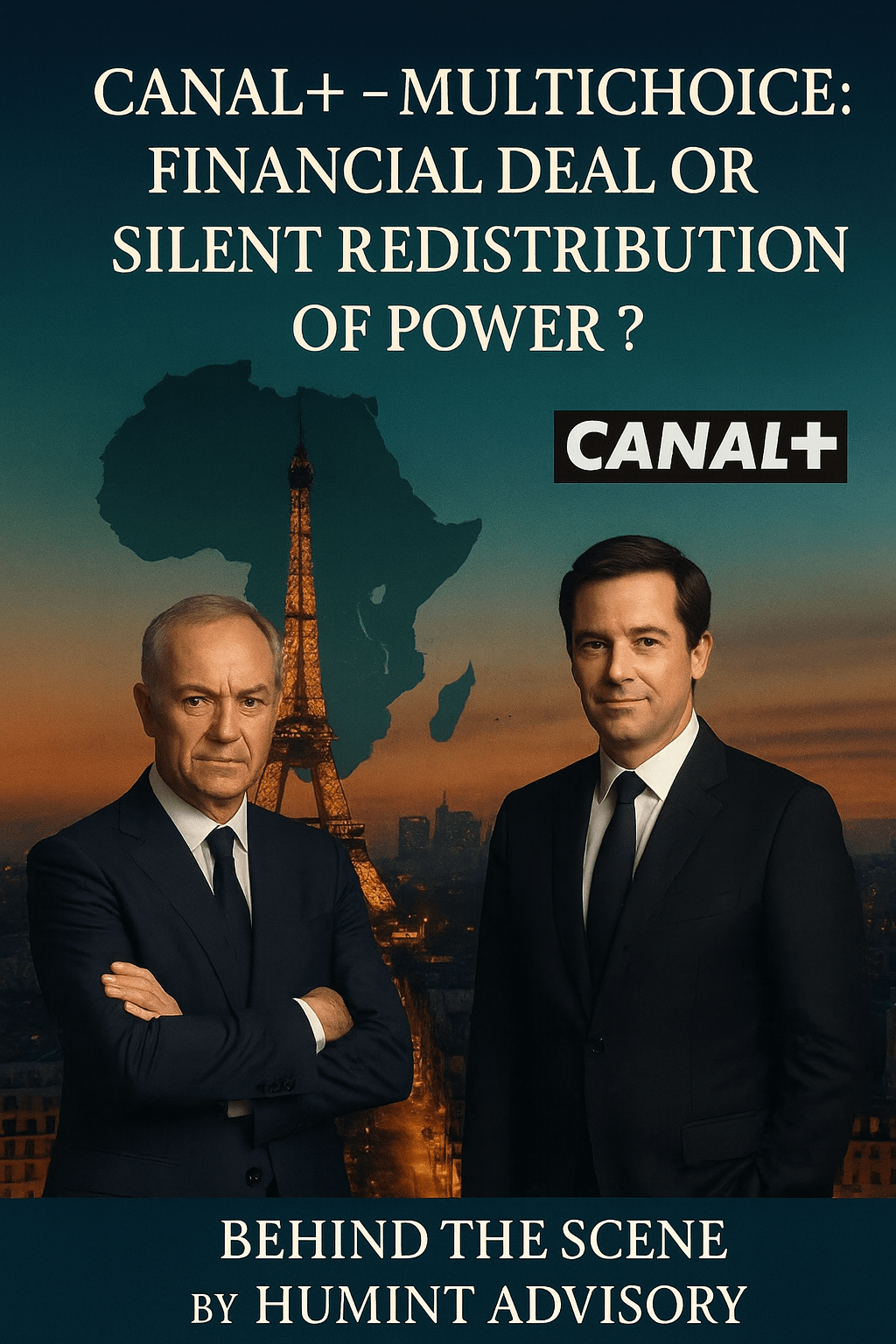
On September 22, 2025, Canal+ completed the $2 billion acquisition of MultiChoice. On paper, the goal is to build an “African giant” with 40 million subscribers across 70 countries. Yet a HUMINT reading reveals an operation that goes far beyond industrial logic: this takeover reshapes governance, influence, and power balances across a strategic continent.
The men behind the curtain.
Maxime Saada, Chairman of Canal+, embodies Parisian centralization. For months, he has orchestrated a plan designed to consolidate decision-making power in Paris, true to Bolloré’s vision. David Mignot, appointed CEO of MultiChoice, has more than 20 years of African experience. His nomination reassures local regulators, but all indications suggest he acts as a bridge between Johannesburg and Paris, with loyalty anchored firmly in Canal+. Nicolas Dandoy, CFO, locks down the financial lever. In such integrations, controlling financial flows is often more strategic than official statements. Calvo Mawela, a respected figure and former MultiChoice CEO, becomes Chairman of Canal+ Africa. A prestigious title with limited decision-making weight — honoring a local stature while reducing real influence.
Every appointment is a signal. Local faces remain on display, but the center of gravity is moving to Paris.
The process: between constraints and engineering.
South African law caps foreign ownership of voting rights in broadcasting at 20%. The solution: “LicenceCo,” an entity controlled by South African investors, notably from historically disadvantaged groups. A legal workaround that respects the letter of the law but, according to sources close to the negotiations, leaves Canal+ with most of the economic and strategic influence.
The human angles.
The three-year moratorium on layoffs does not solve the question of talent loyalty. Already, some executives wonder: will their room to maneuver survive centralization? A silent exodus of top profiles is a serious scenario. Deals can collapse not through lack of subscribers, but through the loss of key people.
The strategic angles.
Competition: The Canal+–MultiChoice alliance commands a near-hegemonic position in sub-Saharan pay TV. Regulators in Nigeria and Kenya are closely watching for signs of “French-ification” of content. Market: inflation, power cuts, widespread piracy. If churn exceeds 10% by the end of 2025, the balance tips. Timing: internal scenarios point to a potential IPO around 2027, but only if synergies in sports rights and local production materialize.
HUMINT below the surface.
Canal+ did not just acquire MultiChoice. It secured a lever of cultural and political influence, a redesigned governance architecture, and an international signal of strength. But the real game lies elsewhere: retaining talent, maintaining regulator confidence, and containing subscriber erosion.
Behind every deal presented as “industrial,” it is always the people who decide the outcome. Knowing who wins, who loses, and why remains the only way to anticipate the future.
#Board #Strategy #Influence #HUMINTAdvisory #SoftPower #Leadership #Canalplus #Canal+
 HUMINT Advisory®
Laisser un commentaire