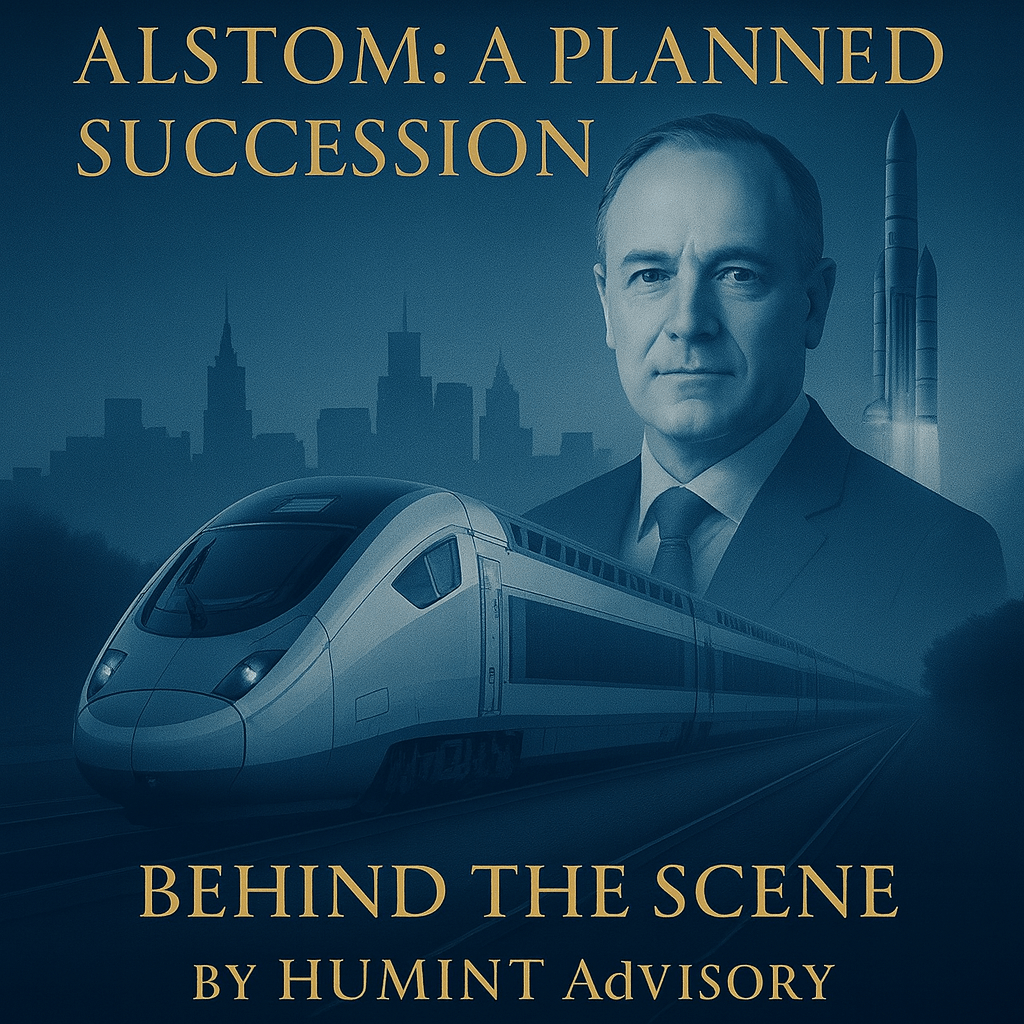
On October 8, Alstom announced that Martin Sion will succeed Henri Poupart-Lafarge as Chief Executive Officer, effective April 1, 2026.
An apparently simple move — a handover after nearly a decade in office.
In reality, a strategic decision, carefully engineered long in advance.
The timeline — more than eleven months of anticipation — signals a deliberate intent to control the transition and avoid disruption.
Alstom emerges from several challenging years: a complex integration of Bombardier, cash-flow pressure, asset disposals, and high-risk projects in the UK and Germany.
The group needs stability — but above all, industrial credibility.
Choosing Martin Sion is not choosing a financier.
It is choosing an engineering integrator, trained at Safran and ArianeGroup, shaped in environments where precision, quality, and technical mastery define economic survival.
Under the chairmanship of Philippe Petitcolin, himself a Safran veteran, the Board sought to inject into rail the discipline of aerospace — a culture of control, process, and measured outcomes.
This succession speaks volumes about the moment Alstom is living through.
It marks the end of a cycle of expansion and the beginning of a cycle of execution.
Institutional shareholders — with CDPQ at the forefront — received a clear signal: transparent compensation, no golden parachute, and a tightly framed non-compete clause.
In other words: continuity, but without complacency.
Behind the calm communication, the stakes are high.
Sion will have eighteen months to read the internal dynamics, identify the true centers of gravity, and assemble a team capable of delivering without friction.
Above all, he must rebuild trust between engineering, finance, and politics — three spheres that have gradually fallen out of alignment.
This extended transition offers him a rare luxury: the time to observe before acting.
But observation only matters to those who know what to look for.
The HUMINT reading suggests this is not merely a governance decision, but a silent rebalancing between technology, power, and influence.
Alstom is not seeking to reinvent itself — it is seeking to re-anchor reality at the heart of its leadership model.
By entrusting the group to a man from the space industry, it sends a clear message: the next conquest will demand the same discipline and precision as going into orbit.
Beyond visible management lies the invisible machinery of power —
where industrial coherence becomes the new form of leadership,
where technical mastery turns into strategic leverage,
and where trust is no longer declared — it is earned, line by line, project by project.
That is where Alstom’s true transition resides: not in a name, but in a way of governing complexity and uncertainty.
And it is precisely on this terrain — that of human discernment and strategic decoding — that organizations stop telling their strategy… and start understanding it.
⸻
#HUMINTAdvisory #TheBelowTheSurface #Alstom #Governance #Industry #SuccessionPlanning #LeadershipTransition #StrategicInfluence #ExecutiveSearch #DecisionMaking
 HUMINT Advisory®
Laisser un commentaire