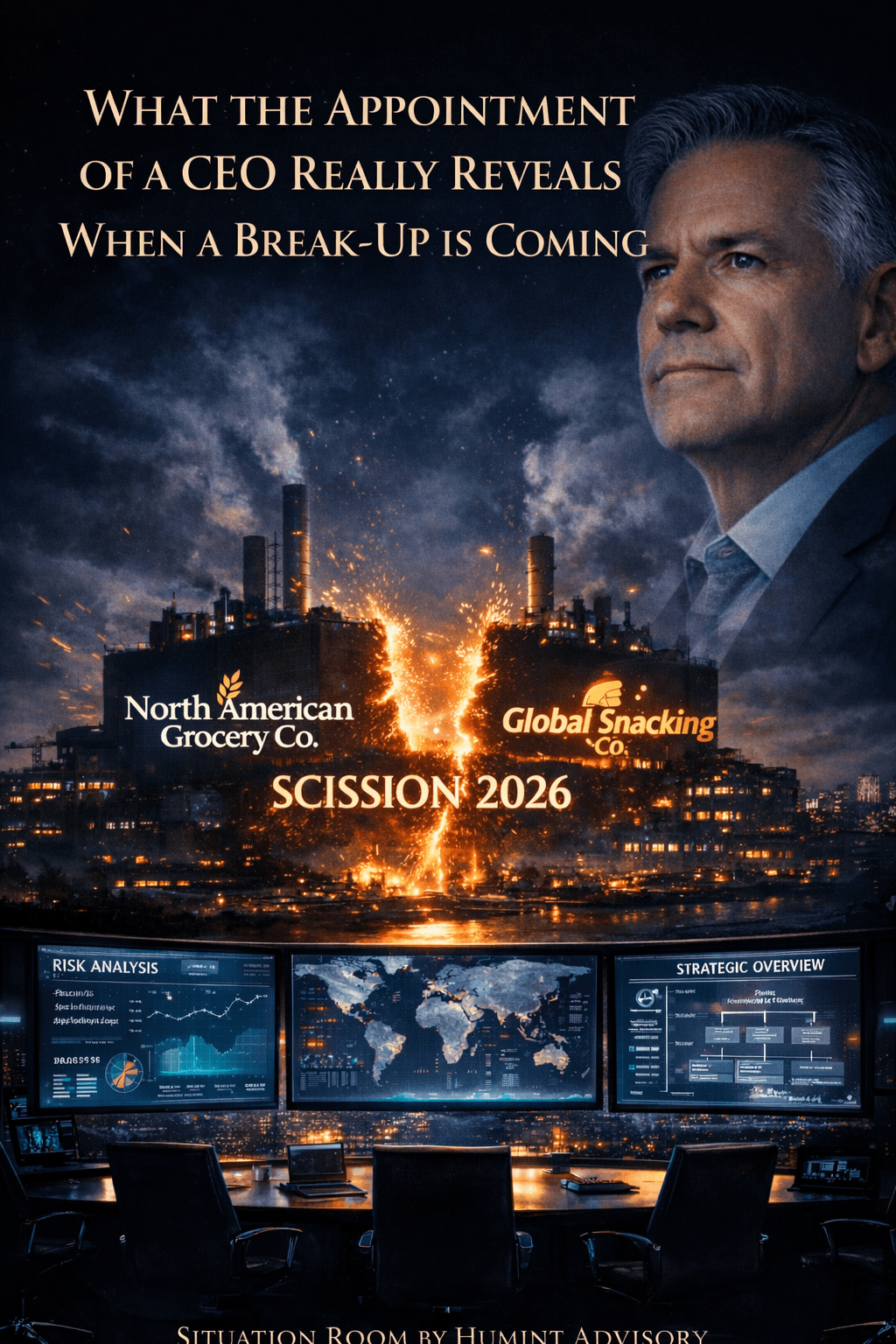
Appointing a CEO at the very moment a strategic split has been decided is never a neutral move.
It is an admission.
And often, a signal only a few insiders know how to read.
The appointment of Steve Cahillane as CEO of Kraft Heinz, while the group prepares to split into two operating entities by 2026, tells a very different story from the official press releases.
This is not about growth.
It is about disentanglement.
Markets know this scenario well.
When Kellogg’s was split — under Cahillane’s leadership — the combined value of the resulting entities rose by nearly 30% within 18 months, despite a period of significant internal instability.
A financial success.
But humanly, an operation under extreme tension.
When a board prepares a break-up, it is not looking for a visionary.
It is looking for an orchestrator of separation.
A leader capable of holding the organization together while loyalties, power structures, and identities begin to shift.
In this type of configuration, the real issue is not the stated strategy.
It is the human capacity to absorb fragmentation.
A split always reveals three invisible truths:
• internal frictions have become more costly than synergies
• decision-making cycles are no longer compatible
• power and influence dynamics have reached a critical threshold
The data confirms it: in major industrial break-ups, over 60% of key departures occur before or immediately after the separation, long before financial impacts stabilize.
The CEO appointed in this context is not there to unify.
He is there to arbitrate, cut through, absorb resistance, and make the separation irreversible.
It is a high-intensity role:
holding firm against silent tensions,
managing undeclared departures,
maintaining a coherent external narrative while the internal fabric weakens.
Most break-ups rarely fail on paper.
They fail humanly, long before the numbers tell the story.
The real risk is not financial.
It is behavioral.
⸻
HUMINT Conclusion
Major strategic decisions are not read in plans.
They are read in the profiles chosen to manage the human discomfort they inevitably create.
⸻
#HumintAdvisory
#DessousDesCartes
#BehavioralStrategy
#ExecutiveLeadership
#BoardroomDynamics
 HUMINT Advisory®
Laisser un commentaire