
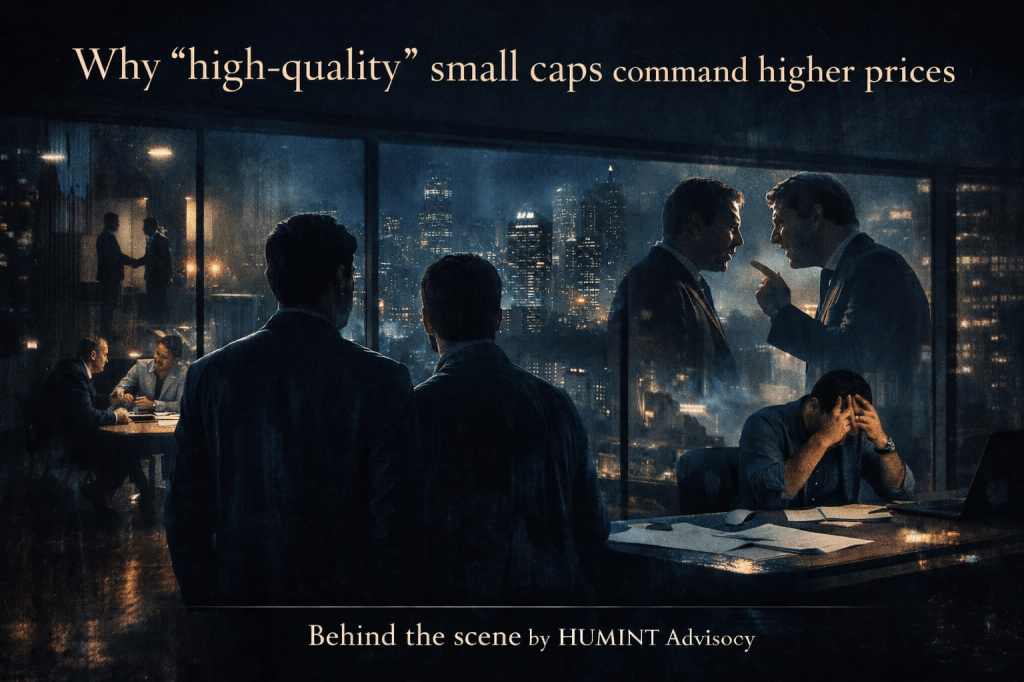
The market hasn’t become irrational.
It has become selective.
And when a market becomes selective, value shifts from performance to predictability.
The higher takeover premiums observed for certain small caps are neither the result of excess liquidity nor blind bets on growth. They reflect a deeper shift in perceived risk. Buyers are no longer paying for what a company delivered yesterday, but for its ability to withstand tomorrow without human disintegration.
In small and mid-cap companies, numbers rarely lie through fraud.
They lie through omission.
They say nothing about internal tensions, critical human dependencies, ego dynamics, or invisible loyalties. Yet these are precisely the variables that determine the fate of a deal after closing.
70% of M&A failures are driven by human and cultural factors (McKinsey & Company).
And yet, these factors remain marginally addressed.
Today’s premium is a human readability premium.
Example (anonymised case):
Two industrial small caps. Same sector. Same growth. Same EBITDA.
One is acquired at a +25% premium. Why?
A CEO capable of absorbing loss of control without defensive rigidity. A leadership team aligned and accustomed to productive disagreement. Power centres identified and acknowledged. Result: fast integration, fluid decision-making, value creation.
The other is sold without a premium. On paper, everything looks identical.
In reality: a founder “officially stepped back” but emotionally omnipresent, a CFO who numbs uncertainty, an untouchable operational star. Six months post-acquisition: passive resistance, blocked arbitrations, discreet sabotage. Value didn’t disappear — it disintegrated.
In a small cap, value does not sit in the org chart.
It sits in the nervous system.
Who truly influences the CEO?
Who slows things down without ever opposing?
Who holds the company’s informal memory?
Who can derail integration without ever being visible?
Current buyer selectivity is not financial.
It is behavioural.
They are not looking for “cheap” targets.
They are looking for non-explosive ones.
In an unstable environment, scarcity is not growth.
It is dynamic stability: the ability of a collective to absorb a change of control without descending into latent conflict, decision paralysis, or the silent exit of key talent.
The premium seen on certain small caps is therefore not excess.
It is a signal of lucid judgement.
The real question is no longer: what is the company worth?
But rather: what will happen when pressure rises?
The human premium is not a cost — it is an investment.
We measure what numbers still cannot see, to prevent value from being lost where no one is looking.
In a world where everything becomes measurable,
what is well decoded — though invisible — becomes the decisive advantage.
#HUMINTAdvisory
 HUMINT Advisory & Executive Search®
Laisser un commentaire