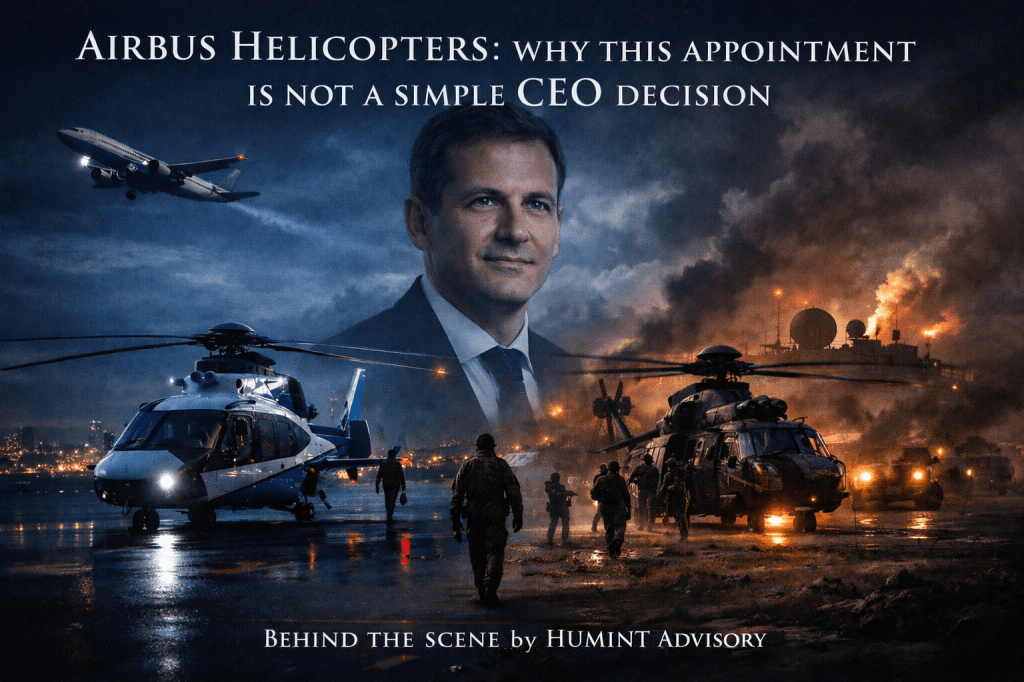
Airbus has appointed Matthieu Louvot as Head of its Helicopters division.
At first glance, a solid, rational, almost self-evident choice.
On closer inspection, it is anything but ordinary.
Airbus Helicopters is not just another business unit.
It is a sovereignty hub:
– spanning civil and military operations,
– directly exposed to states, public budgets and NATO,
– operating under long industrial cycles and heavy political trade-offs.
Here, performance is not decided solely in engineering offices.
It is defined by the ability to hold invisible balances.
Matthieu Louvot’s profile sheds light on this choice.
He is not a “pure helicopter insider.”
He is a leader seasoned in public–private governance, complex institutional environments, and decision-making under multiple constraints.
HUMINT reading:
Airbus is not looking for a disruptor.
Airbus is choosing a conductor of constraints.
This appointment also signals a discreet but clear shift.
Where his predecessor, Bruno Even, embodied a phase driven by innovation, portfolio modernization and technological momentum, the priority now appears elsewhere: strategic control, political clarity and decision continuity.
As illustrated by the trade-offs surrounding the H160 programme—caught between operational requirements, budgetary pressures and NATO standards—decisions are never purely industrial. They are political, partnership-driven and systemic.
So the real question is not “why him?”
But “why now?”
Because the context has changed.
Rising geopolitical tensions.
European rearmament under tight constraints.
Growing pressure on industrial sovereignty and operational credibility.
Inspired by Airbus’ official statement, the stated objective is to “strengthen the strategic steering” of the division.
HUMINT translation: less acceleration, more securing; less transformation, more holding the line.
The message is clear:
– to states: continuity and readability,
– to partners: control of strategic balances,
– to markets: no improvisation in a high-tension environment.
HUMINT Advisory conclusion
This is not an HR decision.
It is a decision of advanced strategic governance.
When an organization entrusts a critical asset to a leader capable of absorbing complexity rather than challenging it head-on,
it knows the next risk will not be technological.
It will be human.
Political.
Systemic.
⸻
#humintadvisory
#governance
#strategicleadership
#aerospaceindustry
 HUMINT Advisory®
Laisser un commentaire