Some appointments tell a story of ambition.
Others reveal a strategic necessity.
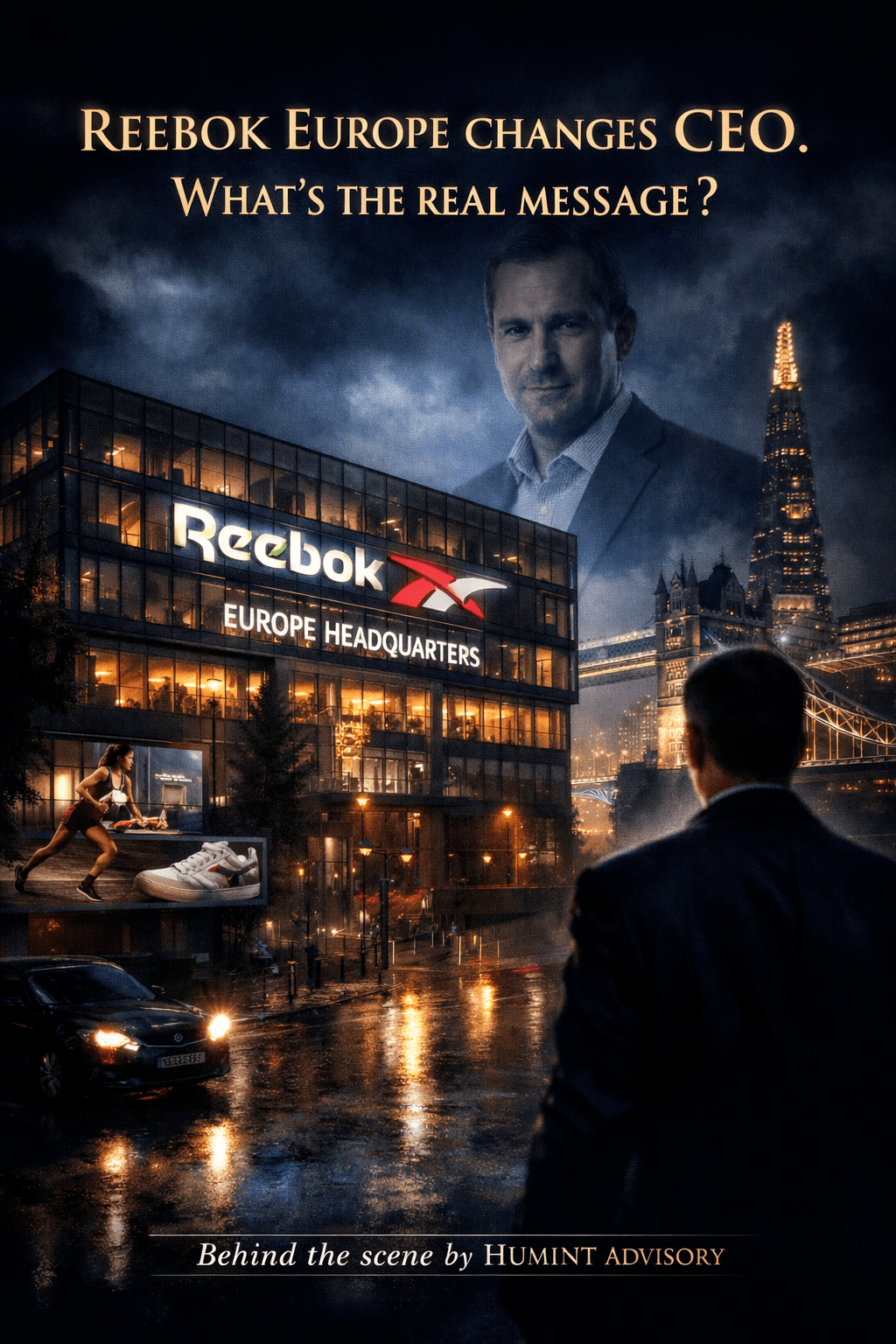
The appointment of Marc Le Roux as CEO Europe at Reebok clearly belongs to the second category.
And that is precisely why it deserves closer scrutiny.
A decision should never be read through its title alone.
It must be read through what it corrects, what it tightens, and what it is not yet ready to say publicly.
Reebok is not a brand lacking ideas.
It is a brand facing decision misalignment.
Between sports heritage and opportunistic athleisure.
Between core European growth markets and regions maintained by inertia.
Between global storytelling and highly uneven on-the-ground realities.
In other words: a brand that knows how to create, but struggles to arbitrate.
In such a context, a European CEO is not appointed to “embody” a vision.
He is appointed to make decisions.
Marc Le Roux is not a showcase profile.
He is an execution, reordering, and clarification profile.
A leader chosen when the time for extended hypotheses comes to an end.
The HUMINT signal is unmistakable:
Reebok acknowledges that its primary challenge is no longer inspiration, but strategic coherence.
This appointment sends three silent messages.
First, internally:
Europe is no longer a diplomatic patchwork, but a perimeter to be actively steered.
Less comfortable consensus.
More decision accountability.
Second, externally:
To distributors, partners, and key markets.
The brand is no longer trying to be everywhere.
It is seeking to be clear, assertive, and differentiated.
Finally, to the board itself:
The exploration cycle is reaching its limit.
The next phase will be one of selection.
Because appointing an operator implicitly means accepting that some decisions will be uncomfortable:
scope reduction, geographic refocusing, channel choices, brand narrative clarification.
This is not a fast-growth appointment.
It is an appointment designed to place the organization under strategic tension.
And in this type of configuration, everything depends on one key factor:
the real decision-making latitude granted to the leader.
A constrained operator becomes a scapegoat.
A supported operator becomes an architect of decision.
In HUMINT advisory, one pattern appears repeatedly:
companies do not change when they lack ideas.
They change when they finally decide to decide.
This appointment is therefore not a marketing signal.
It is an admission of strategic lucidity.
And sometimes, that is exactly what is needed to take back control.
#humintadvisory #strategicdecision #leadershipintelligence #brandstrategy #executivesearch
 HUMINT Advisory®
Laisser un commentaire