Some appointments reassure.
Others quietly reconfigure power.
At Euronext, the confirmation and reinforcement of several CEOs of local venues — London, Lisbon, Amsterdam, Brussels — all integrated into the global Managing Board, is not about political balance.
It is an architectural choice, a response to systemic tension.
Because Euronext’s real battle is no longer symbolic.
It is structural.
Competition from global platforms.
U.S. pressure.
European fragmentation.
Technological acceleration.
Industrialization of flows.
In this environment, governing from the center is no longer enough.
The cockpit must be connected to real market conditions.
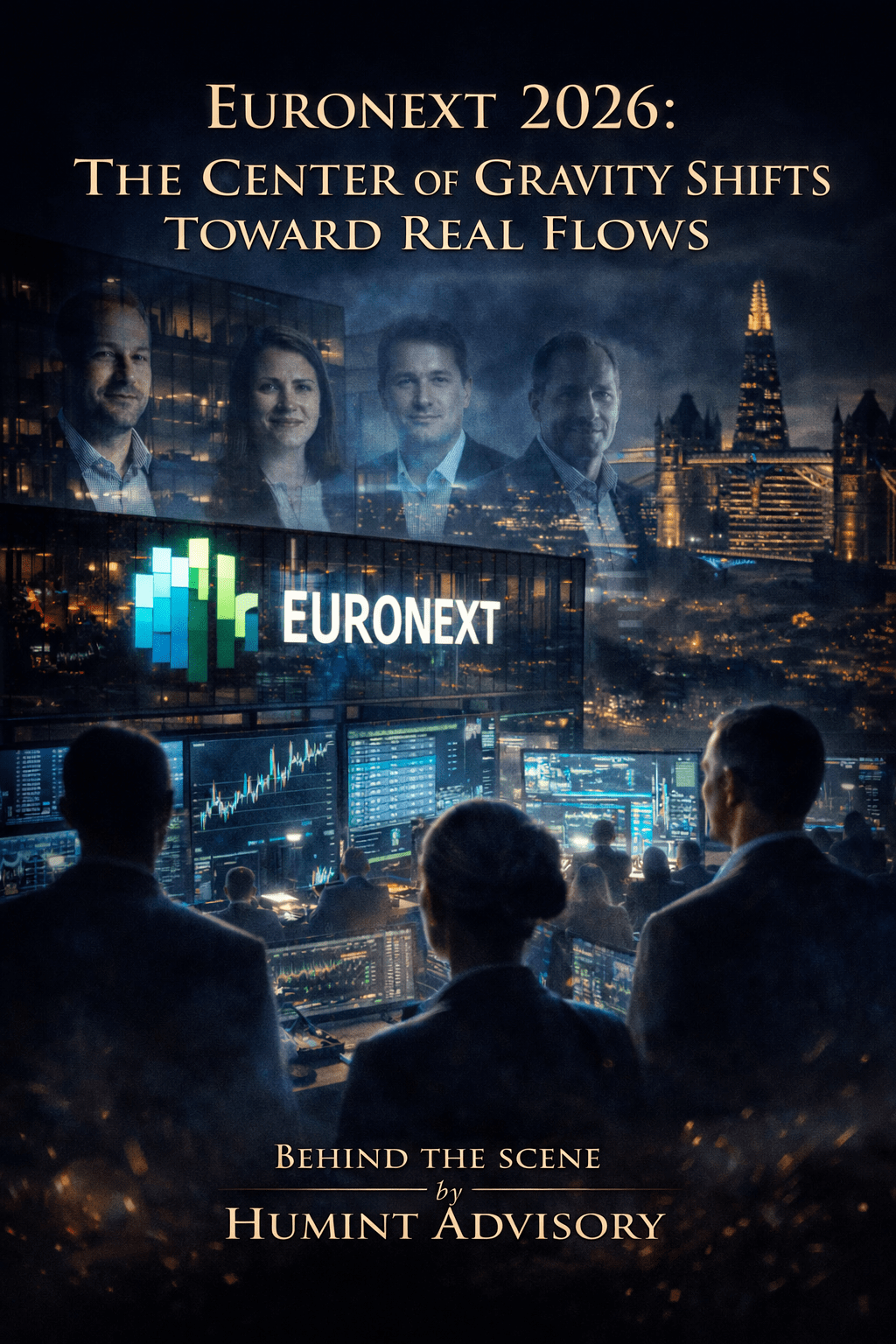
The rising influence of Simon Gallagher, Isabel Ucha, René van Vlerken, and Benoît van den Hove within the global board sends a very clear message:
strategy can no longer be decided at a distance from the markets.
It must be informed by those who capture liquidity, engage with clients, negotiate with regulators, and keep ecosystems under constant tension.
These are not “local” CEOs by tradition or folklore.
They are strategic sensors.
In London, the lever is commercial: client access, volumes, distribution.
In Lisbon, it is politico-financial: issuers, debt, institutions.
In Amsterdam, it is transactional: IPO pipeline, mid-caps, equity credibility.
In Brussels, it is institutional: regulation, trust, and the acceptability of major European initiatives.
Four venues.
Four critical functions.
One clear message: decision-making must be reconnected to real flows.
This move is not isolated.
A similar logic emerged at Nasdaq after the pandemic: stronger regional hubs, greater accountability for local leaders, and faster execution in fragmented market environments.
Same conclusion: when volatility rises, power moves closer to the ground.
Why now?
Because Euronext’s next phase is no longer exploration.
It is execution.
When markets become critical infrastructure,
when technology compresses margins,
when liquidity chooses its pipes,
power can no longer remain abstract.
It must be operational, embodied, and accountable.
Forward-looking view:
if this model holds, by 2027 this distributed governance could accelerate Euronext’s targeted consolidation moves, particularly in Southern Europe — where political, regulatory, and capital alignment becomes a competitive advantage.
We often observe the same pattern:
organizations do not change because they lack ideas.
They change when the cost of non-decision exceeds the risk of deciding.
Euronext is not redrawing its org chart.
It is redrawing its center of gravity.
And when the field enters the boardroom,
it is never trivial.
It is the sign that decision-making has once again become a strategic act in its own right.
#humintadvisory #decisionstrategy #capitalmarkets #governance #leadershipintelligence
 HUMINT Advisory®
Laisser un commentaire