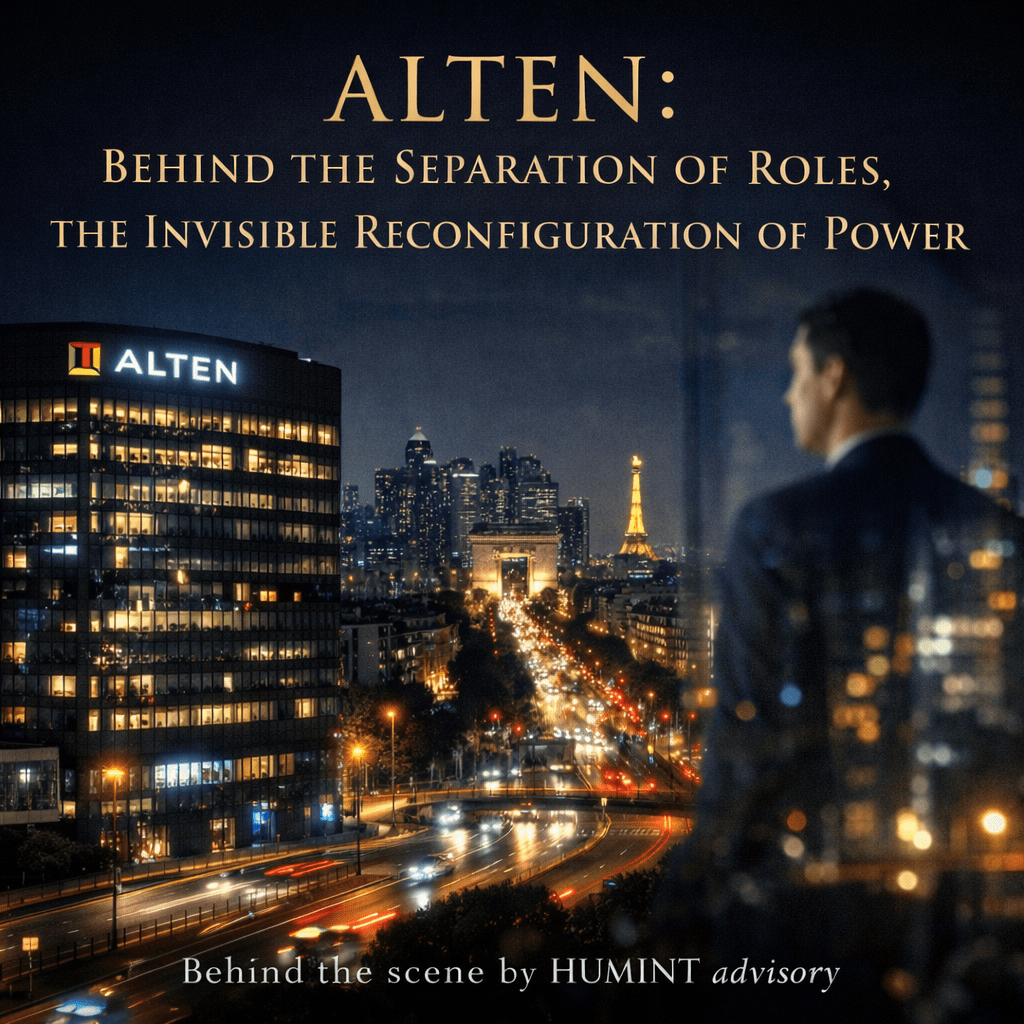
Separating the Chairman and CEO roles is never just an organizational decision.
It is a strategic move — sometimes political, always structural. These shifts typically occur when a company enters a new phase: securing growth, stabilizing market perception, or institutionalizing a model that is still heavily personality-driven.
At ALTEN, the first layer of analysis is immediate:
Simon Azoulay retains approximately 14.7% of the capital. In other words, the separation of roles does not dilute power. It redistributes it over the long term.
The Chairman becomes the architect of capital balance, alliances, and long-range strategic direction.
The CEO carries execution, performance delivery, human arbitration, and operational transformation.
Second layer: why an external CEO — and why this one?
Cyril Malargé comes from Sopra Steria, a direct competitor across several segments. This is not a neutral choice.
An external CEO brings more than expertise.
He brings internal political neutrality. He can carry decisions that an internal legacy figure could no longer push without fracturing the organization.
In moments like these, a leader is selected as much for what he can transform as for what he can transform without triggering systemic conflict.
Third reading: the message sent to markets
The trilogy is classic — and powerful:
Separation of powers.
Stronger governance.
Increased emphasis on independence and audit.
Market reaction reflected this signal:
ALTEN +1.3%
Sopra Steria -3.7%
Implicit reading: the market perceived strategic reinforcement for ALTEN — and a loss of executive capital for Sopra.
Fourth reading: the underestimated cultural factor
ALTEN remains an engineering-driven company, historically identity-strong, almost family-like in certain geographies.
A CEO coming from a more process-driven, service-structured environment can trigger a silent immune response:
formal alignment, operational resistance.
The coming months will reveal whether the integration becomes part of the DNA… or remains an organizational layer.
Fifth HUMINT reading: the “active Chairman” risk
Simon Azoulay stated he would support the transition.
In practice, this often translates into continued influence over:
— long-term strategy
— historical key accounts
— critical leadership appointments
The test will be straightforward:
If Malargé installs his own leadership architecture → strong mandate.
If key roles remain locked within historical ALTEN networks → dual governance.
Final layer: the time factor
A CEO who transforms fast has a clear mandate.
A CEO who adjusts slowly operates under strategic supervision.
A CEO who barely moves is managing a transition designed elsewhere.
Visible governance reassures.
Real governance reshapes power balances.
This is where strategic reading truly happens.
#leadership #governance #boarddynamics #humintadvisory
 HUMINT Advisory®
Laisser un commentaire