
In large corporations, a CEO is almost never replaced because of the present.
They are replaced because of the future.
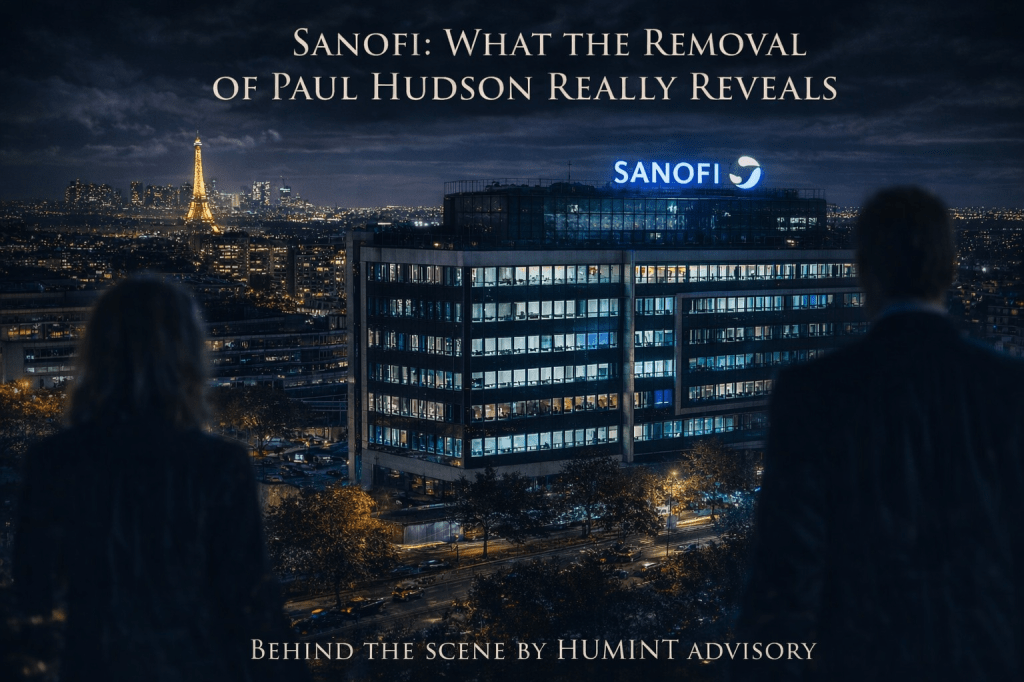
The removal of Paul Hudson and the appointment of Belén Garijo at the helm of Sanofi perfectly illustrates this mechanism of power.
On paper, Hudson was not failing.
In 2025:
• revenue up nearly 10% at constant exchange rates
• earnings per share up 15%
• several recent drug launches.
But boards do not judge trajectories based on past performance.
They judge the credibility of the next strategic cycle.
And this is precisely where the fragility began to appear.
Today, Sanofi relies heavily on a single product: Dupixent.
A blockbuster drug… whose key patents will start expiring in the early 2030s.
For investors, the core question is simple:
what will be the next engine of growth?
Several weak signals started to worry the market in 2025:
• clinical results perceived as underwhelming on key molecules
• limited visibility on the post-Dupixent pipeline
• growing pressure on the vaccine business in the United States.
In other words:
the strategy existed.
But confidence in its speed of execution was beginning to crack.
This is exactly the kind of moment when a board acts.
Not when the crisis is visible.
But when strategic doubt starts to emerge.
The appointment of Belén Garijo is therefore not simply a leadership change.
It is a governance recalibration.
And one detail reveals the strength of that decision:
the board agreed to modify the statutory CEO age limit to make her appointment possible.
In boardroom language, this means one thing:
this was not an opportunistic choice.
It was a conviction decision.
Why her?
Three strategic reasons.
She knows Sanofi from the inside (15 years in the company and member of the executive team during the Genzyme integration).
She was leading Merck KGaA, a group known for strong scientific and strategic discipline.
And her hybrid profile — physician, global executive, experienced board member — speaks simultaneously to scientists, investors, and regulators.
Her implicit mission is clear:
• accelerate R&D execution
• restore pipeline credibility
• prepare the post-Dupixent era.
In reality, Sanofi is not changing its strategy.
The board is changing the speed and discipline of its execution.
And this is often where the most important decisions in large organizations are made.
Because the real power of a board is not just to define strategy.
It is to decide when the conductor must change.
That is what this move truly reveals.
And that is precisely what the HUMINT lens seeks to uncover:
the invisible decision-making dynamics behind visible announcements.
#humintadvisory
 HUMINT Advisory®
Laisser un commentaire