
When a company launches a product capable of reshaping its market, the natural reflex is to focus on technology.
But in reality, visible performance is almost always the outcome of a chain of invisible decisions.
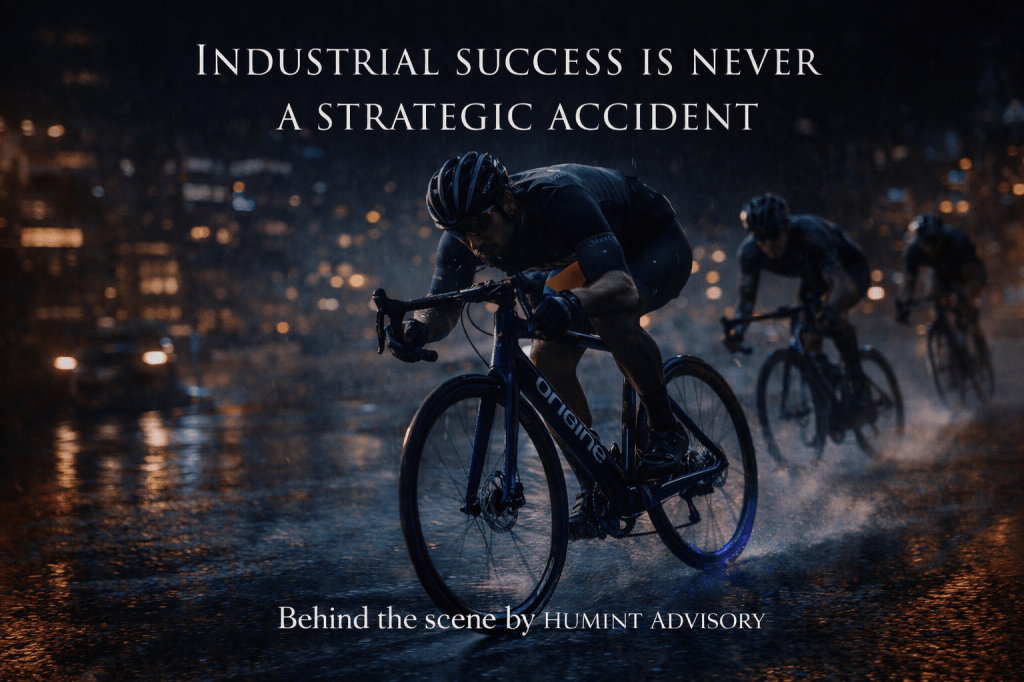
The launch of the Newton[e] by Origine Cycles offers a compelling illustration.
Presented as one of the lightest electric bikes in the world at 9.83 kg, the bike combines a carbon frame, the Mahle X20 drive system (~1.4 kg) and a 236 Wh integrated battery.
Official range reaches 100 km, extendable to 160 km with an additional battery. Real-world testing typically places effective range closer to 70–80 km, depending on terrain and assistance level.
Yet the technology is only the visible layer.
Founded in 2012, Origine Cycles made a decisive strategic choice early on: design, assemble and sell directly to the customer, through an online configurator offering more than 17 million possible combinations.
This direct-to-consumer model fundamentally changes the economics.
It preserves control over product design, margins and customer experience — a decisive advantage in the premium segment where strategic coherence matters more than scale.
The numbers confirm the trajectory.
The company sold around 5,500 bikes in 2021, with an average selling price above €3,000, generating revenues that now exceed €20 million.
The entry of LBO France in 2022 marked a turning point: industrial expansion, increased production capacity and the opening of a 7,500 m² manufacturing site in northern France, targeting 50 bikes assembled per day with roughly 100 employees.
In a rapidly expanding market — more than 670,000 e-bikes sold in France in 2023, nearly one out of three bicycles — Origine chose a counter-intuitive strategy.
While most manufacturers compete on motor power and battery capacity, Origine focused on lightness and seamless integration.
In other words: designing an e-bike that preserves the DNA and riding feel of a traditional road bike.
This decision was not primarily technological.
It was a market insight.
Understanding that a segment of premium cyclists does not simply want electric assistance — they want to extend their performance without losing their identity as cyclists.
This is where human intelligence becomes strategic.
Breakthrough innovations rarely emerge from engineering alone.
They usually result from a far rarer combination:
clear strategic vision,
a complementary founding team,
capital able to support long-term growth,
and disciplined decision-making.
Challenges remain — intensifying global competition, supply-chain dependencies, and increasing industrial cost pressures.
But these constraints are part of the strategic equation.
The most durable industrial successes come from organizations capable of aligning vision, product, capital and execution around a deep understanding of the market.
Technology makes innovation possible.
Human intelligence makes it strategically durable.
#humintadvisory
 HUMINT Advisory®
Laisser un commentaire