
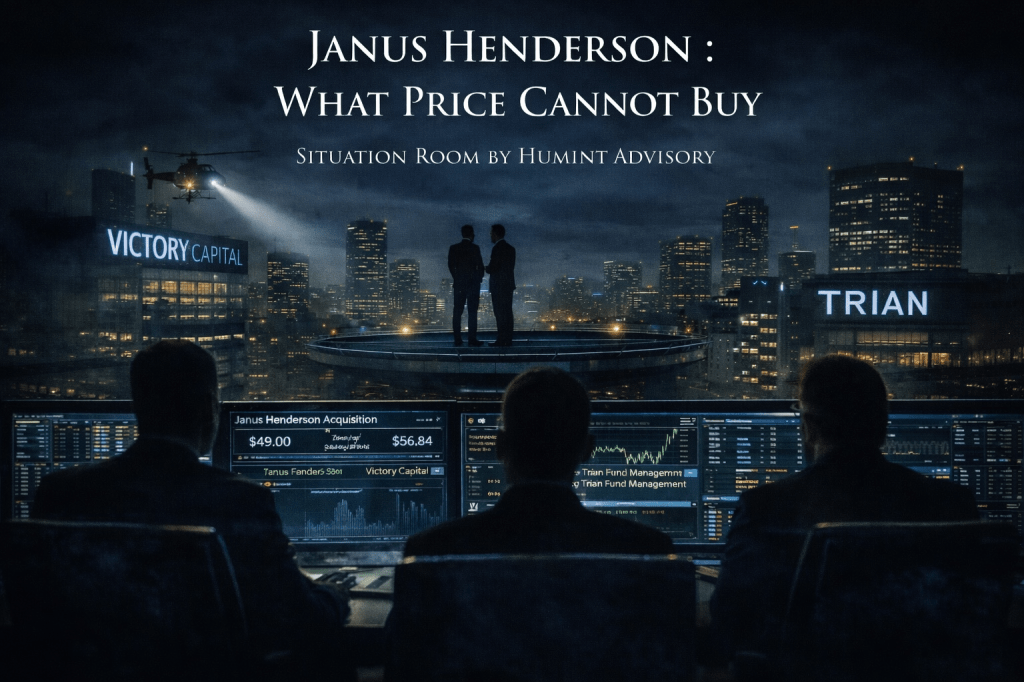
Situation Room — HUMINT Advisory
⸻
On paper, the decision should be straightforward.
Victory Capital puts forward a superior offer: more cash, higher headline value.
Trian Fund Management maintains a lower bid—but a more secure one.
And yet, Janus Henderson rejects the highest offer.
This is not an anomaly.
It’s a signal.
What the market sees
A classic battle:
a more attractive hostile bid a less generous friendly deal a board making the call
Financial reading: inconsistency.
What’s really happening
The board is not choosing the best offer.
It is choosing the scenario that holds after closing.
In asset management, value does not sit in the assets.
It sits in:
clients portfolio managers trust
And that value can disappear before the deal is even completed.
The breaking points
Victory’s rejection is built on three major risks:
1. Client consent
Some mandates require explicit approval in case of change of control.
Without it, assets can walk out.
2. Talent attrition
Key teams were reportedly ready to leave.
In this industry, departures equal immediate value destruction.
3. Execution risk
More complex structure, equity exposure, longer timelines.
The HUMINT shift
Victory controls the price.
Trian controls the system.
With:
~20% of the capital already locked board-level influence management continuity stronger internal and client acceptance
The balance of power is already tilted.
What the board is really protecting
Not the price.
But operational integrity.
Because the wrong acquirer can destroy value before even paying for it.
Situation Room reading
This case rests on a simple principle:
A deal is not won at signing.
It is won in the ability to keep the system intact.
Victory offers more.
But fails to prove it can:
secure clients retain talent stabilize the organization
Conclusion
Janus is not rejecting an offer.
It is rejecting a risk.
In modern control battles, power does not belong to the highest bidder.
It belongs to the one perceived as capable of breaking nothing.
⸻
#humintadvisory
 HUMINT Advisory®
Laisser un commentaire