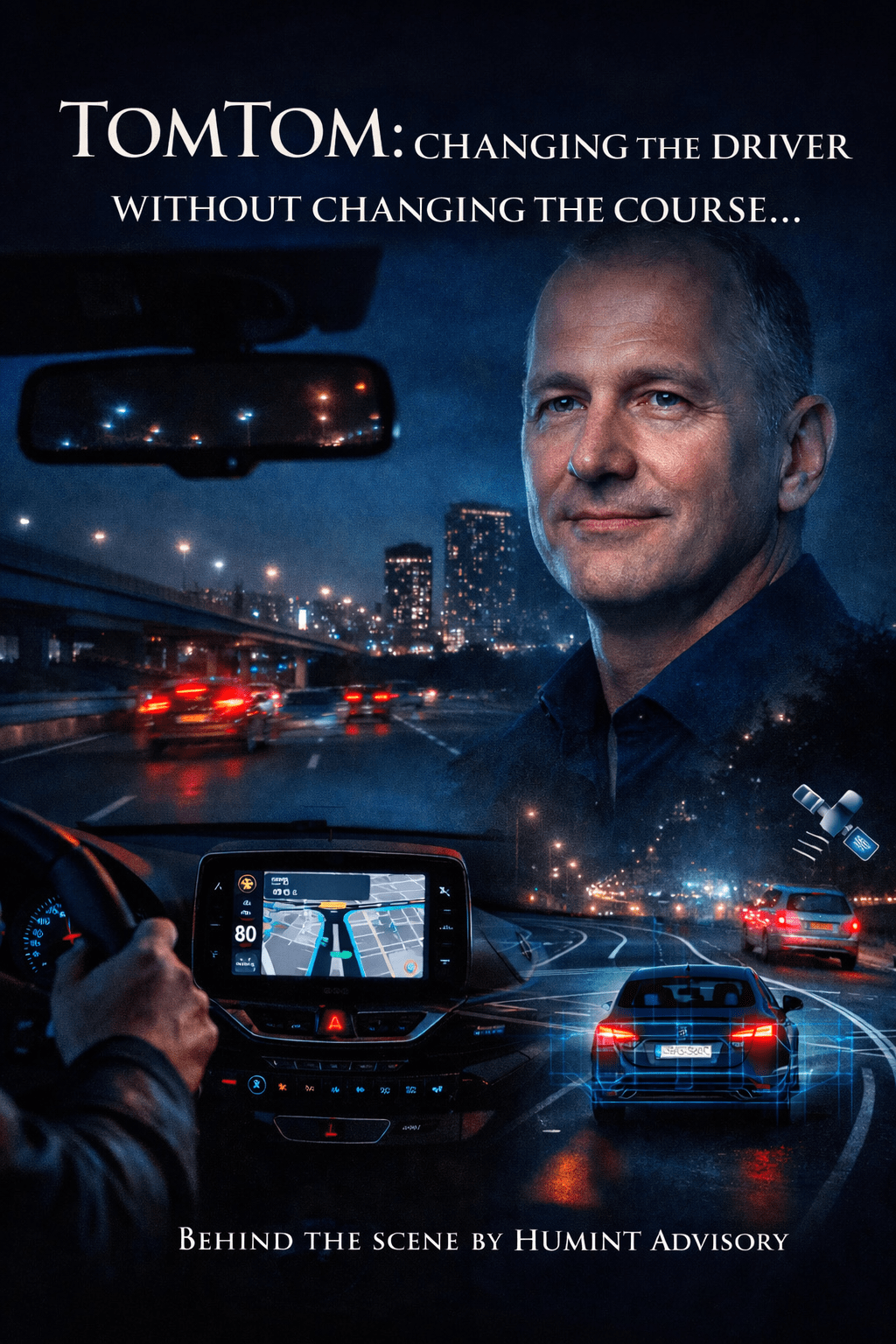
Behind the appointment of Mike Schoofs as CEO of TomTom, a deeper strategic reality is unfolding: this is not a transition—it’s a phase shift.
€555M in revenue in 2025, down 3%.
A pressured automotive market.
Overwhelming competition from platforms like Google and Apple.
And yet: record automotive order intake, structural partnerships (Microsoft, Uber), and a credible next-generation mapping stack.
The HUMINT signal is clear: TomTom is no longer trying to prove it can build. It’s trying to prove it can convert.
The choice of Schoofs, former Chief Revenue Officer, is not neutral. He is neither a product visionary, nor a financial operator, nor an external disruptor. He is a revenue architect—focused on traction, deal-making, and strategic closing. In other words: a monetization executor in a system that has already defined its thesis.
This is where the real shift happens.
When a board keeps the founder (Harold Goddijn) at the supervisory level, it does more than preserve institutional memory—it locks the trajectory. No rupture. No cultural discontinuity. A controlled transition designed to reassure clients, partners, and investors.
Behavioral reading: the board is not buying a vision—it is buying the ability to reduce uncertainty.
Because the core risk is no longer technological. It is economic.
Turning a mapping platform into recurring revenue streams.
Turning partnerships into strategic dependency.
Turning a European asset into a credible alternative to U.S. giants.
The keyword is not growth. It’s conversion.
In this context, appointing a CRO as CEO is a strong strategic signal: the question is no longer “what to build,” but “how to monetize at scale.”
A useful comparison: Valeo, 2022.
Same internal succession logic.
Same retention of the historical leader as chairman.
But a different choice: an operations-driven profile to industrialize transformation.
TomTom takes the opposite route.
Valeo had to produce better.
TomTom must sell better.
That is the difference.
The implicit bet is clear: Schoofs must turn technological advantage into a value-capture machine—without breaking internal balance, without over-depending on platforms, and without losing the battle for data sovereignty.
Three invisible risks emerge:
– a revenue-driven CEO in a still deeply technological war
– continuity that extends blind spots
– limited autonomy under a present founder
But the real issue lies elsewhere.
TomTom is entering its moment of truth.
No longer the domain of engineers.
But of decision-makers.
And in that space, the question is no longer: “are we good?”
But: “are we indispensable?”
#HUMINTAdvisory
 HUMINT Advisory®
Laisser un commentaire