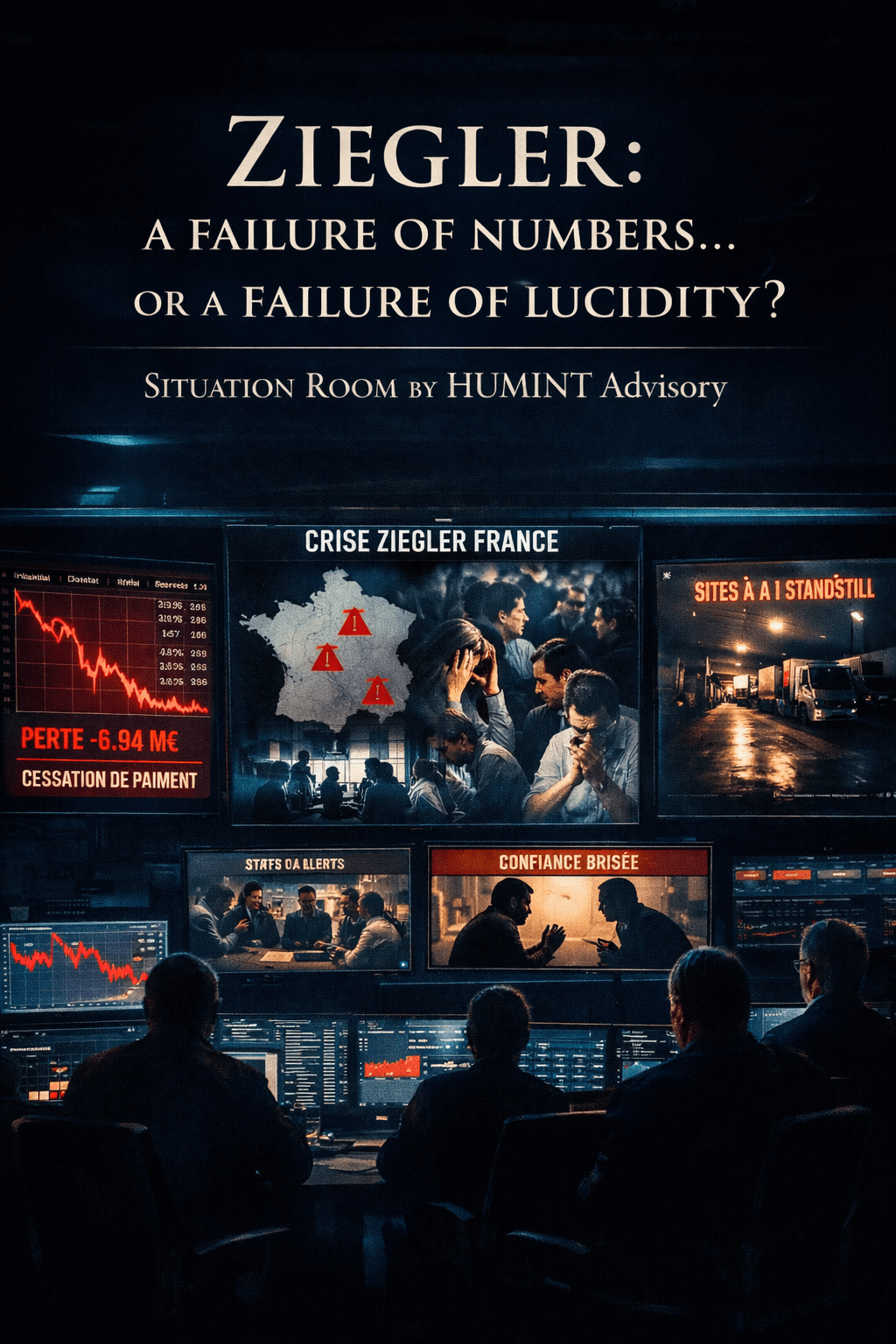
On March 31, 2026, the Commercial Court of Lille ordered the liquidation of Ziegler France.
1,400 to 1,500 jobs are affected.
The cessation of payments was set retroactively to September 3, 2024.
In other words:
the reality was already there… 18 months before the official collapse.
In the meantime?
Revenue remained high (over €400M),
but profitability deteriorated (net losses close to €7M, negative EBITDA),
subcontractors went unpaid for months,
sites came to a standstill,
employees were left without activity,
and social signals became critical (formal alerts, rising anxiety).
And yet, in 2025:
new site openings, continued investments, business as usual.
This is where HUMINT reading begins.
A company does not collapse when numbers decline.
It collapses when the organization no longer believes its own weak signals.
At Ziegler, everything was visible:
→ operations teams saw the drop in activity
→ partners felt the cash pressure
→ employee representatives raised alarms
→ the transport market was already under structural pressure
But these signals were never turned into decisions.
Why?
Because data is not enough.
It must be interpreted… and accepted.
The group was stable, embodied, family-driven.
A CEO in place since 2017.
A coherent governance structure.
Until January 2026.
Abrupt replacement of the CEO.
Ad hoc administrators appointed in February.
Judicial restructuring in March.
The signal is clear:
decisions came… when the situation was already critical.
Behavioral reading:
• Continuity bias: believing the situation would normalize
• Bubble effect: filtering out uncomfortable signals
• Centralization: slowing down decision-making
• Strategic denial: failure to reframe a cyclical issue as structural
But above all:
A silent breakdown of trust.
In transport, the real asset is not the balance sheet.
It is network trust.
When subcontractors refuse to operate,
when clients redirect flows,
when teams start to doubt,
the collapse is already underway.
Long before the courts step in.
What Ziegler reveals is not poor management.
It is a misalignment between perception and decision.
The numbers said “tension.”
The field said “rupture.”
The decision said “wait.”
This is where value collapses.
For CEOs, funds, and boards:
The question is not:
“Do I have the right data?”
But:
“Am I ready to hear what it truly implies?”
HUMINT does not replace numbers.
It reveals the moment when they are no longer enough.
And that moment… never forgives.
#HUMINTAdvisory
 HUMINT Advisory®
Laisser un commentaire