The Iran shock didn’t just push oil prices higher.
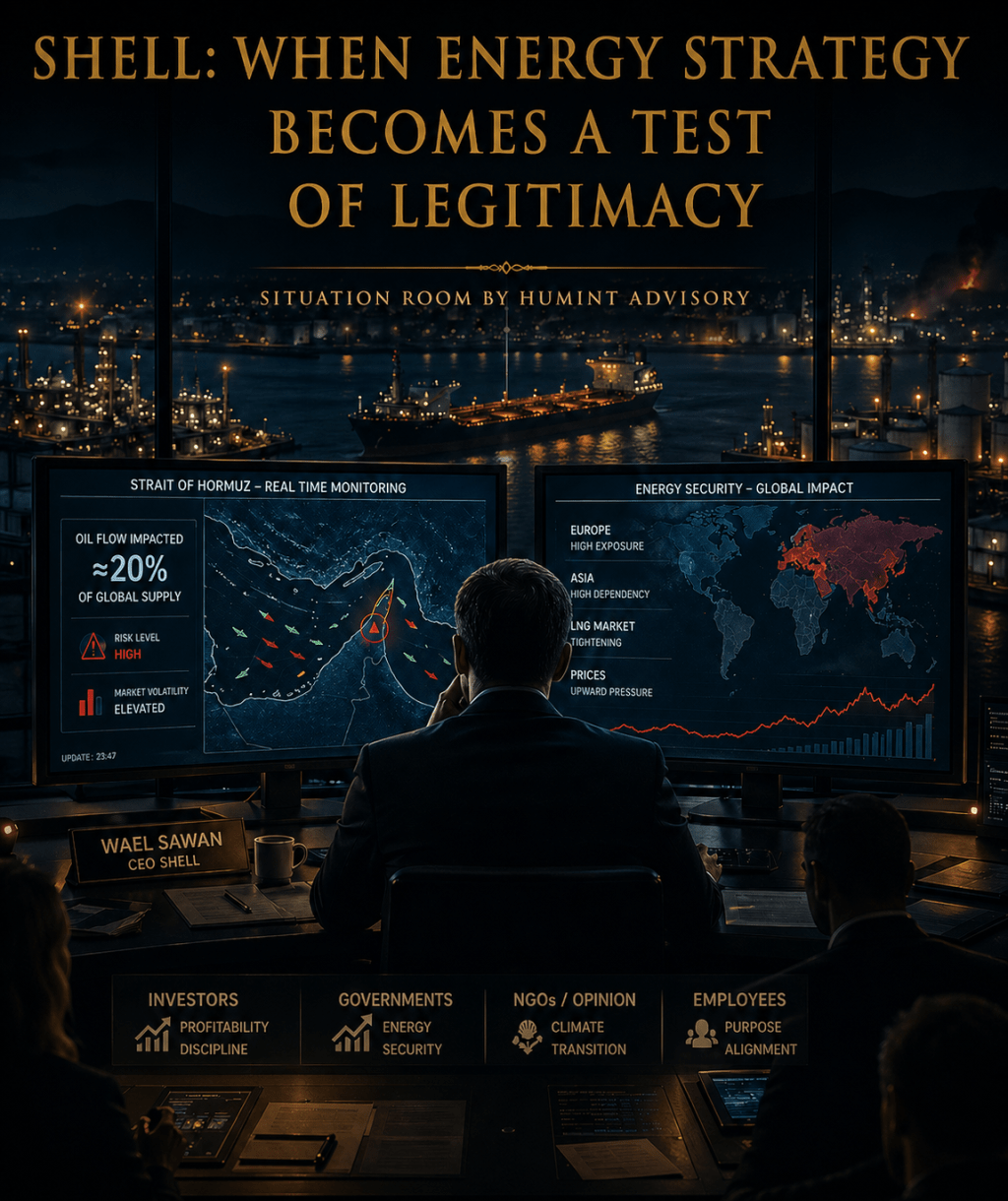
It reignited a critical risk: disruption in the Strait of Hormuz, through which nearly 20% of global energy flows transit.
Not a full shutdown.
But enough uncertainty to reshape decisions.
In this context, Shell plc changes status.
From energy player to balancing force.
Because in recent months, Shell has made clear choices:
– doubling down on LNG
– maintaining hydrocarbon investments
– returning 40–50% of cash flow to shareholders
Rational decisions.
Until the environment shifts.
Wael Sawan now operates in a rare zone:
making decisions that are energy-critical,
yet politically and socially interpreted.
A concrete example:
Expanding gas today
means securing Europe and Asia.
But it also fuels criticism from NGOs and ESG investors,
who see it as slowing the energy transition—and have already challenged parts of Shell’s LNG strategy.
Same decision.
Two opposing interpretations.
This is where HUMINT dynamics begin.
Internally, weak signals are already visible:
– LNG and trading teams gaining influence
– transition teams losing centrality
– decisions becoming faster, more financially driven
Nothing unusual.
But one key question emerges:
is everyone still reading the strategy the same way?
Because organizations don’t drift when strategy changes.
They drift when it is no longer understood consistently.
Externally, pressure intensifies.
The more Shell secures supply,
the more its performance may be perceived as tied to crisis.
War profit?
Or necessary stabilization?
Leaders are now judged on two fronts:
what they actually do,
and how it is perceived.
And this is where leadership is defined:
in the ability to align reality and perception.
Under Ben van Beurden, Shell could still balance
transition and profitability.
Today, Wael Sawan is arbitrating between:
immediate energy security
investor pressure
and societal legitimacy
Three forces.
None fully aligned.
In this kind of environment,
the real risk is not making the wrong decision.
It’s misreading where the actual tension lies:
in the assets?
in the teams?
or in external perception?
Because in moments like these,
strategies don’t fail.
Interpretations diverge.
And that’s where everything shifts.
Reading decisions is no longer enough.
You have to read the invisible dynamics:
who influences,
who aligns,
who doubts—silently.
Because ultimately,
in this type of crisis,
the edge is not informational.
It’s human.
#HumintAdvisory


Votre commentaire