
What most people see in Lisa Su is a tech battle with NVIDIA.
What they miss is a decision-making tension.
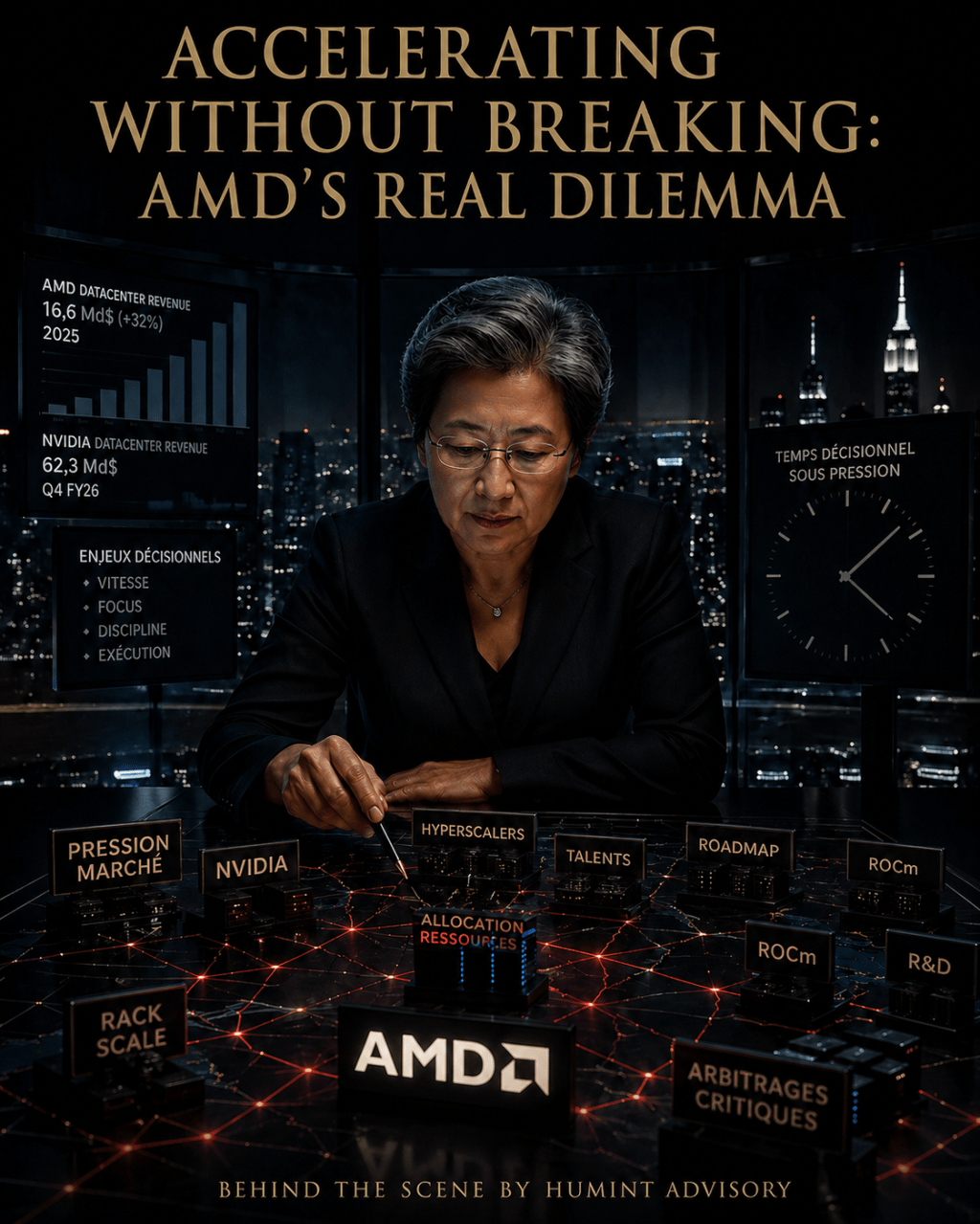
AMD delivered $34.6B in 2025, including $16.6B in Data Center (+32%).
NVIDIA? $62.3B… in a single Data Center quarter.
That’s not a gap.
It’s a constraint.
And constraints force acceleration.
MI300 rollout. MI350/400 ramp. OpenAI and Meta deals. ZT Systems acquisition to control rack-scale.
AMD isn’t just executing a strategy anymore.
It’s being pulled by the market’s tempo.
That’s where risk begins.
Because acceleration doesn’t just create growth.
It creates distortion.
Distorted priorities.
Distorted resource allocation.
Distorted decision timelines.
In a company built on discipline — AMD’s core strength under Lisa Su — this leads to something critical:
the gradual erosion of decision hierarchy.
What it looks like:
• Data Center absorbing resources at the expense of Client and Gaming
• ROCm becoming mission-critical, yet still chasing CUDA
• Hyperscalers setting the pace, compressing internal cycles
• Product, engineering, and commercial teams no longer operating on the same clock
Result?
A coherent system becomes a stressed system.
And the risk won’t show up in quarterly numbers.
It shows up in decisions.
The more opportunities you have, the harder it is to stay disciplined.
Counterintuitive—but that’s exactly what hurt Intel in the 2010s:
Not lack of resources.
But strategic dispersion.
Delayed trade-offs.
Blurred priorities.
While the market accelerated, internal coherence broke down.
And NVIDIA took the lead.
This isn’t a tech story.
It’s a decision-making one.
Today, AMD faces the inverse pressure:
Too slow → irrelevant in AI.
Too fast → break the execution engine.
Lisa Su is operating in a narrow zone:
move fast—without losing the discipline that made AMD competitive.
That’s a rare equation.
And it plays out in weak signals:
• shorter decision cycles
• growing dependence on market expectations
• extreme resource concentration
• invisible decision fatigue at the top
• silent friction across divisions
HUMINT read:
speed is becoming a source of internal instability.
And here’s the classic mistake:
Leaders think the risk is external.
It’s not.
It’s internal.
Preserving execution discipline isn’t about slowing down.
It’s about protecting fixed points:
• decisions that stay deliberate
• non-negotiable priorities
• trade-offs shielded from market pressure
Otherwise, speed creates the illusion of control…
while quietly breaking the system.
AMD’s real challenge isn’t catching NVIDIA.
It’s staying aligned while trying.
And you won’t see that in announcements.
You’ll see it in the quality of decisions made under pressure.
#HumintAdvisory


Votre commentaire