For decades, luxury was about selling objects.
Today, it is about controlling territories of experience.
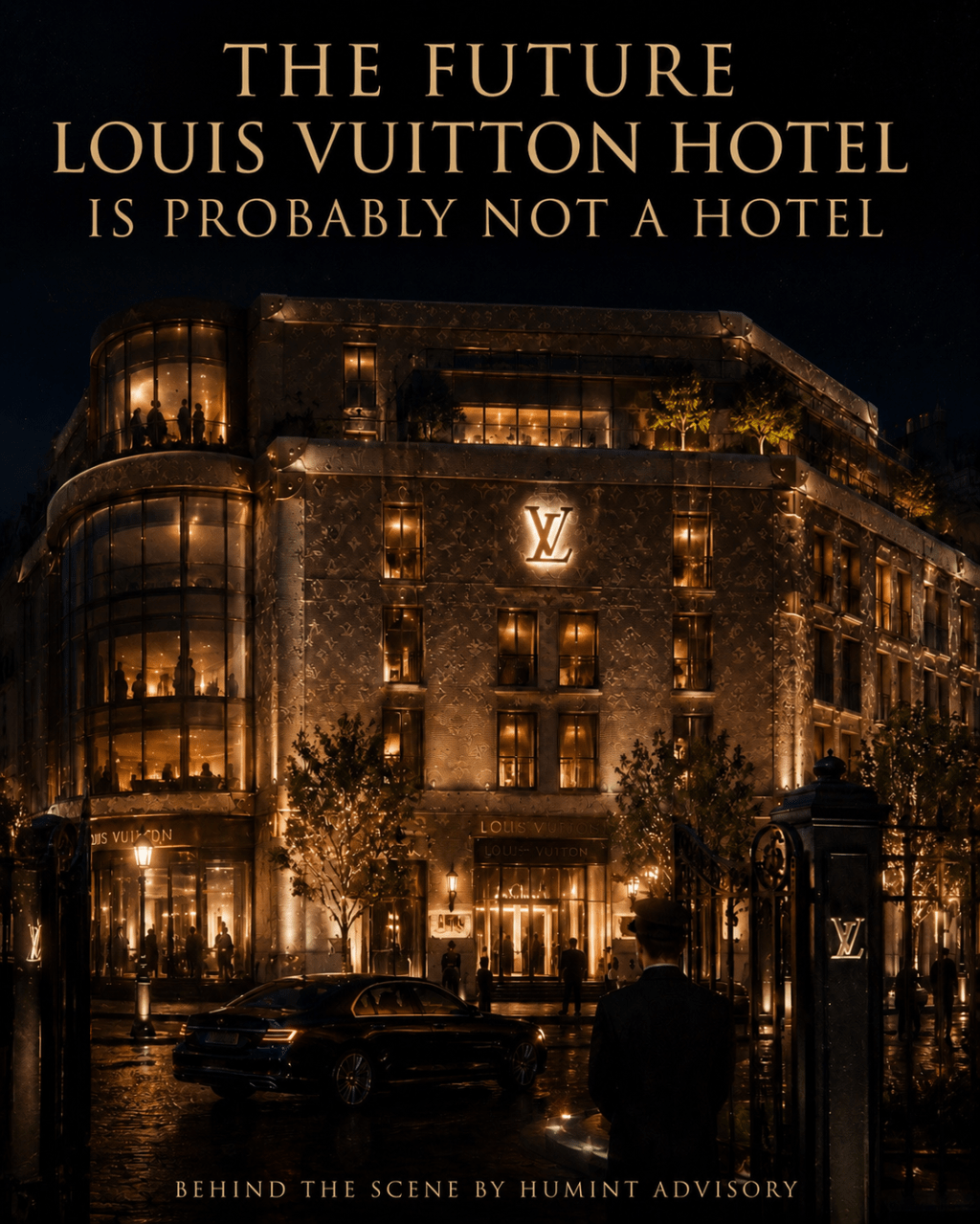
The future Louis Vuitton hotel at 103-111 Avenue des Champs-Élysées is therefore not a simple “lifestyle” diversification.
It is a far deeper strategic move.
LVMH is not discovering hospitality.
The group already owns Cheval Blanc and acquired Belmond for $3.2 billion to enter the ultra-premium travel space.
But with Louis Vuitton, the signal changes.
Cheval Blanc was a hospitality house backed by LVMH.
The future Louis Vuitton hotel is different: the brand itself becomes the destination.
And this is where the subject becomes fascinating through a HUMINT lens.
Because a luxury hotel is not a store.
A store sells a projection.
A hotel reveals behavior.
Time spent.
Real expectations.
Relationship to service.
Need for recognition.
Tolerance for waiting.
Search for intimacy.
Ability to pay for absolute rarity.
Ultra-luxury hospitality is an exceptional behavioral observatory.
At its core, LVMH is not simply trying to host its clients.
It is trying to extend the emotional relationship with them.
The product creates desire.
The experience creates attachment.
And above all: it exposes the true culture of an organization.
Because in ultra-luxury, human execution always reveals what marketing sometimes tries to smooth over.
The choice of the Champs-Élysées is equally strategic.
It is not just a commercial avenue.
It is a global stage for symbolic power, premium tourism, and international visibility.
Perhaps the most interesting aspect remains the project’s rumored positioning: very few suites, massive space, extreme selectivity.
In contemporary luxury, rarity alone is no longer enough.
Access itself now has to be staged.
Armani understood this early with Armani Hotels.
Bulgari did the same with Bulgari Hotels.
But many luxury houses merely transposed their aesthetics into hospitality.
LVMH appears to be aiming for something else:
transforming Louis Vuitton into a complete experiential ecosystem.
Retail.
Culture.
Dining.
Hospitality.
Lifestyle.
Architecture.
Travel.
A closed, coherent, immersive universe.
The risk is enormous.
Because hospitality forgives nothing.
In fashion, clients sometimes buy a narrative.
In hospitality, they experience the operational truth of the brand.
And this is probably where the real “dessous des cartes” begins.
The future of luxury may no longer belong to the houses that create the most beautiful objects.
But to those capable of designing the most controlled human experiences.
In this model, the product becomes almost secondary.
What truly matters is the feeling of having been admitted into a closed world.
And in ultra-luxury, access eventually becomes more valuable than the object itself.
#HumintAdvisory


Votre commentaire