
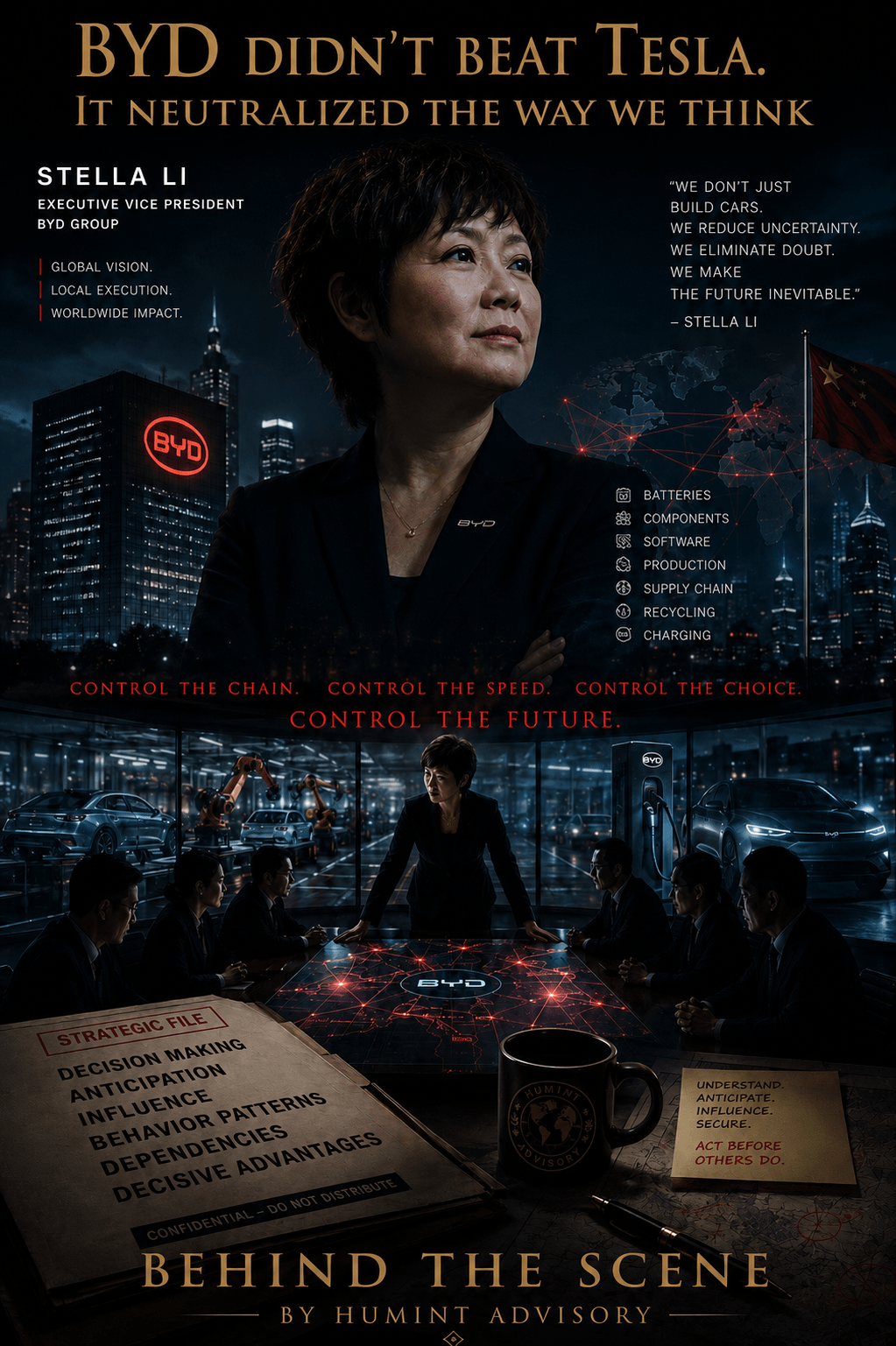
While the West was watching Tesla as a technological revolution driven by one man, BYD was building something else entirely: a silent architecture of industrial, behavioral, and decision-making control.
The classic analytical mistake is to believe BYD sells cars.
It doesn’t. BYD reduces uncertainty.
And today, the player that reduces uncertainty dominates the one that communicates best.
The weak signal lies in the profile of Stella Li herself, Executive Vice President of the group. Until recently, she remained largely under the radar in the West. She does not come from traditional automotive storytelling. She emerged from inside the BYD system itself.
Scientific background. Operational culture. Execution discipline. Deep command of international markets.
Her role is not to embody a Musk-like messianic vision.
Her role is far more strategic:
To make BYD acceptable, credible, and ultimately inevitable outside China.
This type of profile is revealing: little visible ego, strong emotional control, calibrated language, no ideological friction, and the ability to reassure without ever exposing the true center of gravity of the system.
Because the real power inside BYD is not media-driven.
It is organizational.
The group operates less like a car manufacturer and more like an industrial sovereignty structure under permanent pressure. Every decision appears driven by one central logic:
Never become fully dependent on any critical external actor.
Batteries.
Components.
Software.
Production.
Supply chain.
Recycling.
Charging.
BYD is not pursuing Western aesthetic perfection.
It is pursuing total strategic autonomy.
That is what many still fail to detect.
Tesla thinks in disruption.
BYD thinks in endurance.
Tesla optimizes visible innovation.
BYD optimizes systemic resilience.
And that changes everything inside the decision-making process.
At BYD, speed is not merely technological.
It is cognitive.
Decision loops are shorter because the system is less fragmented. Fewer external dependencies. Fewer internal political validations. Fewer visible ego wars.
The group operates through: useful compartmentalization, execution discipline, engineer-dominated culture, and an obsession with controlling critical variables.
Its real strength is probably there:
Turning the automotive industry into a theater of behavioral engineering.
Price becomes a psychological weapon.
Ultra-fast charging becomes a tool to neutralize customer anxiety.
Vertical integration becomes a mechanism of silent domination.
While others sell a car, BYD reduces mental resistance to adoption.
And this is precisely where the real HUMINT issue begins.
In certain sensitive missions, the real question is never:
“Who is stronger?”
The real question is:
“Who controls the dependencies, the fears, the real decision circuits, and the behavioral blind spots?”
BYD appears to have understood before many others that modern markets are no longer won through technology alone.
They are won through the mastery of human, industrial, and decision-making vulnerabilities.


Votre commentaire