Most discussions focus on the 737 MAX, quality failures, production delays, and the FAA.
Those issues are real.
But they are the visible symptoms.
The real issue sits one layer deeper:
Inside an organization operating under constant global scrutiny, who still dares to make decisions — and at what personal cost?
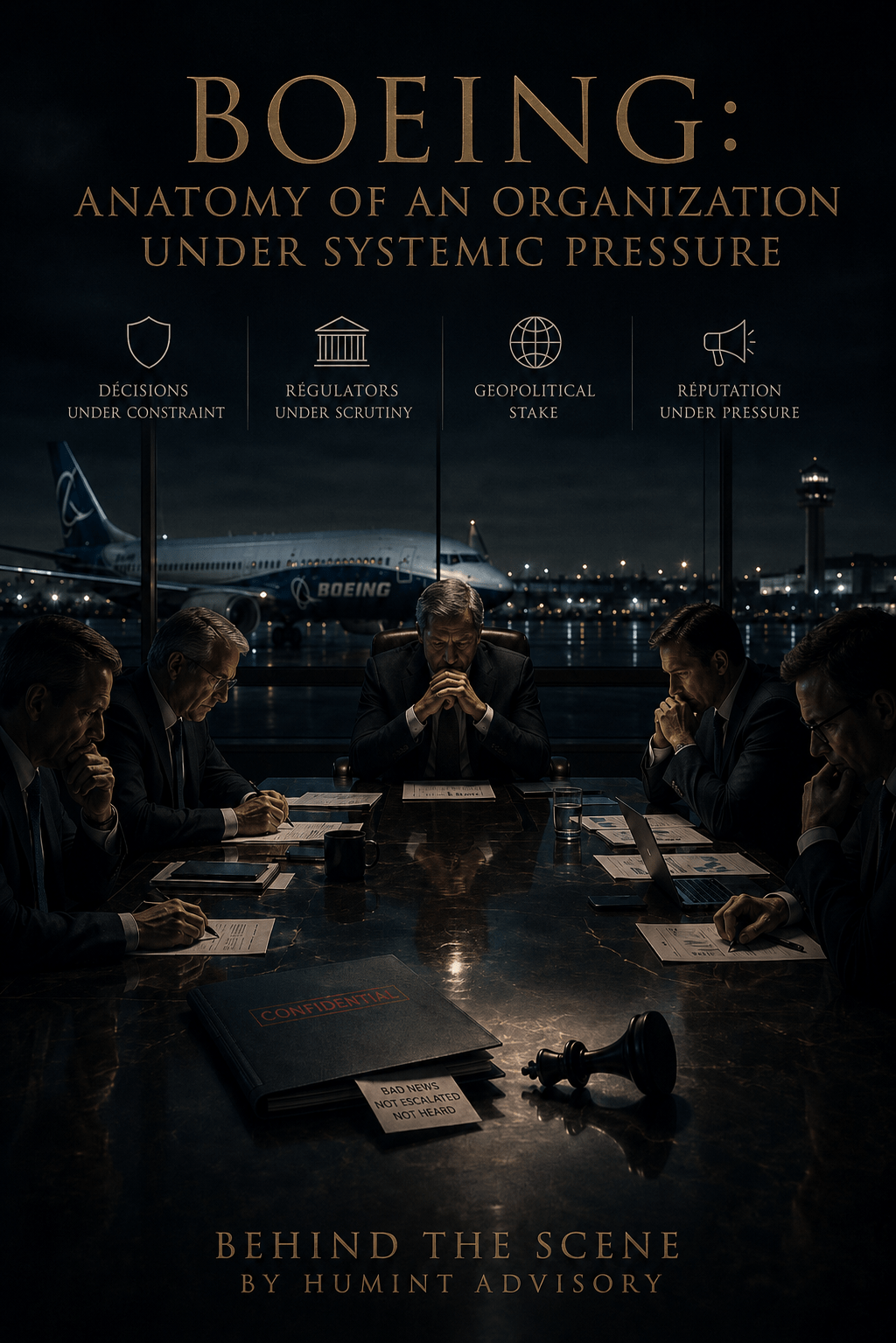
After years of crisis, Boeing has drifted into a pattern well known in organizations exposed to prolonged turbulence: decision layering.
Hierarchies begin protecting one another.
Operational teams spend more time documenting than deciding.
Legal departments enter the process earlier.
Weak signals take longer to surface because nobody wants to be the person carrying the bad news that could trigger the next crisis.
In aerospace, a few days of decision friction can translate into billions.
At this stage, the issue is no longer just technical quality.
It has become the psychological fluidity of decision-making.
That is precisely why Kelly Ortberg was chosen: not to embody a bold new vision, but to restore a form of operational trust inside a system where every major decision now carries regulatory, financial, media, political, and diplomatic consequences.
The behavioral consequences are almost mechanical:
Aggressive profiles become more cautious.
Middle management filters more information.
Bad news travels more slowly.
Industrial trade-offs become increasingly political.
Airbus is watching these dynamics closely. But reducing the situation to a simplistic “good student vs. bad student” narrative would be a strategic mistake.
Boeing remains a core strategic asset for the United States. Recent contracts secured during diplomatic trips are reminders of a simple reality: in critical industries, the line between industrial competition and state power is extremely porous.
And this is precisely the moment when organizational charts stop explaining how a company truly functions.
The real work is no longer about producing another layer of reporting.
It is about mapping the invisible dynamics:
• Where are the real decision bottlenecks?
• Which critical information is no longer reaching the top?
• Which executives are overcompensating — or withdrawing — under pressure?
• Where does organizational silence begin to emerge?
• And who still retains the clarity to see the system as it truly is?
Because at this stage, the problem is barely industrial anymore.
It has become behavioral, political, and systemic.
And this is often where the real ability of a global company to recover — or fail — is ultimately decided.
In organizations under systemic pressure, real speed is no longer measured on the production line.
It is measured by how long it takes for bad news to still reach the CEO honestly.
#HumintAdvisory


Votre commentaire