
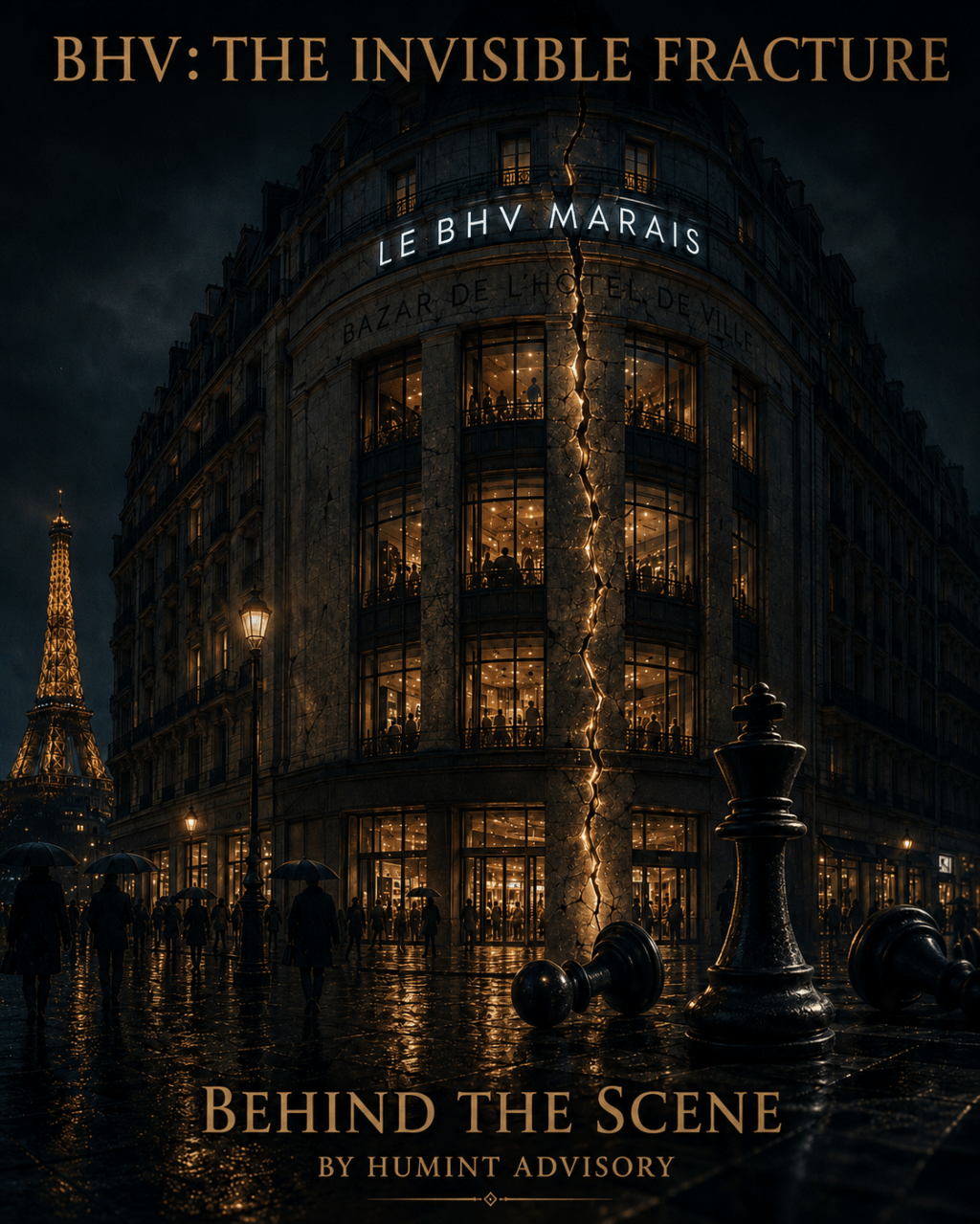
When an iconic department store in the heart of Paris starts simultaneously losing supplier confidence, customer anchors, commercial coherence, and part of its symbolic credibility… the issue goes far beyond a simple marketing controversy.
BHV was already losing between €15M and €20M a year before its acquisition.
Suppliers are now reporting payment delays.
Entire sections are gradually emptying out.
Renovations are dragging on until 2027.
And at the same time, disruptive decisions are being made to recreate traffic, accelerate flow, and reassure an increasingly nervous ecosystem.
This is precisely where the case becomes fascinating from a HUMINT perspective.
Because many organizations do not die economically first.
They die behaviorally.
Their decisions become incoherent long before their financials become irreversible.
And historically, the mechanism is often the same:
Some legacy media brands sacrificed editorial integrity for audience metrics.
Some luxury houses diluted rarity through over-distribution and volume obsession.
Some iconic retailers slowly started thinking more like real estate assets than emotional brands.
Each time, the problem was never the isolated decision itself.
The problem was the growing fracture between deep identity… and real-world strategic choices.
And this is often where leadership psychology changes under pressure.
When debt, real estate exposure, rents, banks, shareholders, and timelines start dominating the equation, leaders gradually stop protecting a vision.
They start managing immediate survival.
At that point, decisions become tactically rational…
but strategically destructive.
And that may be one of the major risks here:
applying a turnaround formula that may work on smaller commercial assets… to an institution carrying decades of collective memory, Parisian identity, and emotional capital.
Because a place like BHV does not operate on traffic alone.
It operates on narrative coherence.
And narrative coherence can be analyzed very concretely.
The moment a brand starts sending conflicting signals simultaneously about:
• its real positioning,
• the type of customers it attracts,
• the brands it hosts,
• its relationship to pricing,
• its level of desirability,
• its historical story,
• or even the emotional experience people feel inside the space…
the market instinctively detects a fracture.
Even unconsciously.
That is exactly what makes certain transformations so dangerous:
each decision appears individually defensible;
but collectively, they begin telling the story of a company that no longer fully knows what it has become.
And from there, everything slowly starts drifting:
suppliers reduce exposure,
partners become cautious,
teams lose their internal narrative,
legacy customers emotionally disconnect.
Then comes the critical moment:
the moment an institution starts chasing traffic before rebuilding meaning.
And historically, that is often the precise moment when institutions truly begin to die.
Not loudly.
But through the slow erosion of coherence between what they once were… and what they now project.
#HumintAdvisory


Votre commentaire