For decades, luxury hospitality operated on a simple equation: own the best locations in the world.
Four Seasons seems to have realized that the next battle will not be fought over places.
It will be fought over control of the experience.
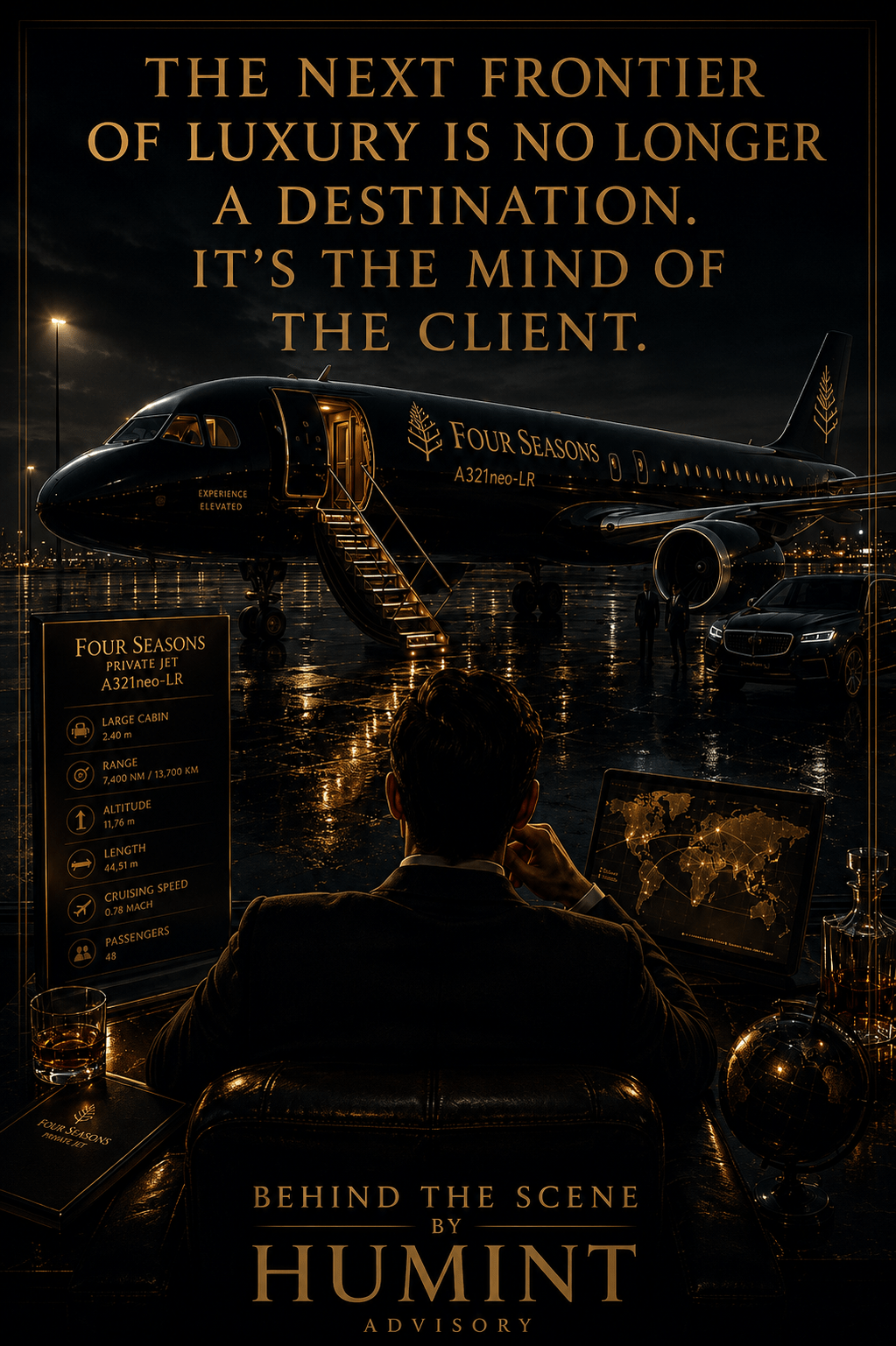
A 48-seat Airbus A321neo-LR.
A dedicated concierge.
An executive chef.
A physician on board.
Journeys spanning multiple continents.
At first glance, the announcement looks like a natural extension of luxury.
In reality, it reveals something far more profound.
Because Four Seasons is no longer selling a hotel.
It isn’t even selling travel.
It’s selling a bubble.
A psychological, social, and behavioral bubble where clients are shielded from the friction of the outside world.
For years, the world’s most exposed executives have faced a form of inflation that rarely appears on any balance sheet.
Not financial inflation.
Cognitive inflation.
Every day they must decide, prioritize, anticipate, negotiate, and control.
The ultimate luxury is no longer space.
It has become freedom from mental burden.
Four Seasons is not responding to a transportation need.
It is responding to decision fatigue.
What it offers is far rarer than comfort:
the delegation of uncertainty.
But the most interesting signal lies elsewhere.
Why 48 passengers?
Why not push the concept to its logical extreme and build an ultra-exclusive jet reserved for a handful of billionaires?
Because Four Seasons didn’t build a product.
It built a tribe.
A temporary community of individuals who may never have met, yet share the same codes, expectations, and—most importantly—the same level of trust in the brand.
We often observe a recurring phenomenon in HUMINT:
people rarely place their trust in institutions.
They place their trust in those who curate their environment.
That is exactly what Four Seasons is doing.
The brand becomes a social filter.
It implicitly guarantees that the other 47 passengers belong to the same behavioral universe.
The client is not simply buying a seat.
They are buying confidence in the people around them.
That may be the most valuable asset in the entire operation.
Because when a brand becomes a mechanism for social selection, it ceases to be a brand.
It becomes an institution.
Behind this decision lies an even larger strategic shift.
For a century, hospitality companies sold destinations.
Today, some are beginning to sell complete ecosystems.
The hotel.
The yacht.
The jet.
Tomorrow, perhaps residences, healthcare, education, or mobility.
The objective is no longer to own a moment of the customer journey.
It is to own the journey itself.
It is probably no coincidence that, at the same time, luxury houses such as Louis Vuitton appear less interested in hospitality as a business and more interested in hospitality as a platform of influence.
The product is no longer the room.
It is the world the customer chooses to live in.
And that is where the real story begins.
Four Seasons is not trying to compete with private aviation.
It is trying to become the trusted operator of a global elite whose scarcest resource is no longer money.
It is attention.
In this context, the jet is not transportation.
It is a capture mechanism.
The yacht is not a vessel.
It is an extension.
The hotel is no longer a destination.
It is an anchor point within a much larger system.
Observers see diversification.
Strategists see a deliberate attempt to privatize the human experience end-to-end.
And when a company begins to control not a product, but the environment in which decisions are made, it enters an entirely different category.
The category of influence.
#HumintAdvisory


Votre commentaire