For nearly twenty years, the challenge was simple: sell.
Today, the challenge has become far more complex: absorb success without losing control.
That is likely what is unfolding around Éric Trappier at Dassault Aviation.
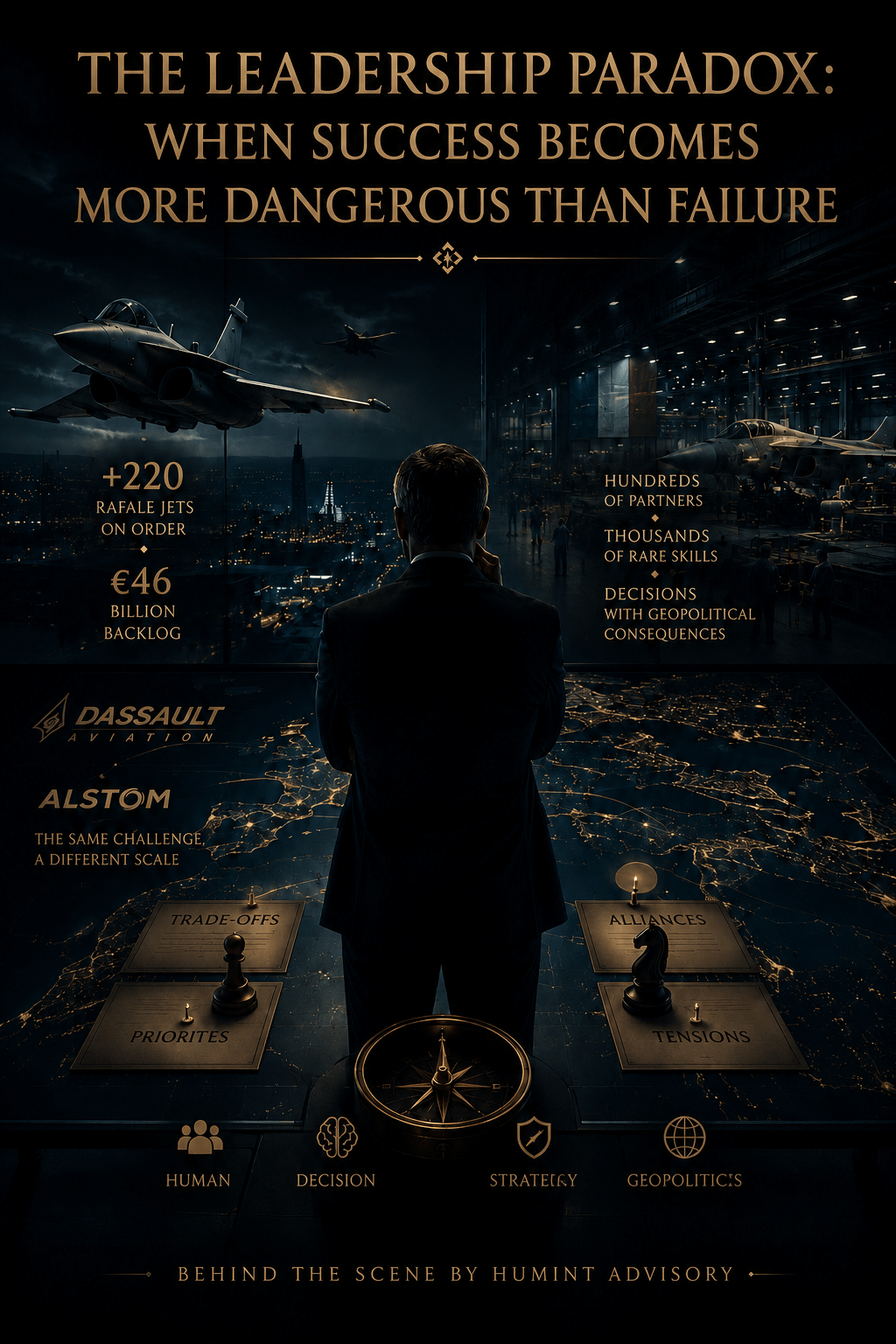
With more than 220 Rafale fighter jets on order and a backlog exceeding €46 billion, most observers see an extraordinary industrial success story.
We see something else.
A gradual rise in decision-making pressure.
Because beyond a certain point, a leader is no longer managing a company.
He is managing a constant series of trade-offs.
Who gets delivered first?
Which customer must wait?
Which program takes priority?
Which political relationship must be preserved?
Which industrial tension is acceptable?
These decisions never appear in annual reports.
Yet they often determine the future of an organization.
French industrial history has already provided several examples.
At Alstom, periods of rapid growth demonstrated that winning contracts was not always the hardest part.
The real challenge was aligning industrial capacity, human resources, suppliers, timelines, and customer expectations simultaneously.
When demand grows faster than an organization’s ability to absorb it, the nature of risk changes.
The challenge is no longer commercial.
It becomes human.
In the defense industry, that reality is even more acute.
Behind every Rafale delivered stands a network of hundreds of companies, thousands of highly specialized professionals, and decision chains where industrial leaders, military officials, and political stakeholders intersect.
But the greatest risk emerges elsewhere.
As pressure builds, information travels less effectively.
Warnings from the field become harder to hear.
Critical trade-offs move upward.
Decision circles become smaller.
And the leader becomes increasingly isolated.
This is a classic phenomenon we observe in high-pressure environments.
Not a technical failure.
A gradual deterioration in decision quality.
Organizations rarely weaken because of a single major strategic mistake.
More often, they are eroded by a succession of constrained decisions made with incomplete visibility into operational reality.
The higher the stakes, the denser the influence networks become.
The more sensitive the trade-offs, the more stakeholders seek to shape the outcome.
And the greater the pressure, the greater the risk of disconnection between the executive suite and the reality on the ground.
The real question is therefore not whether Dassault will produce more aircraft.
The real question is whether its leadership can maintain decision quality when every available option carries political, industrial, and human costs.
Because in a world shaped by permanent conflict, the scarcest resource is no longer capital.
It is not even technology.
It is clarity.
And as is often the case, the most decisive strategic disruptions emerge from the invisible part of the iceberg.
#HUMINTAdvisory


Votre commentaire