At first, the decision seemed perfectly rational.
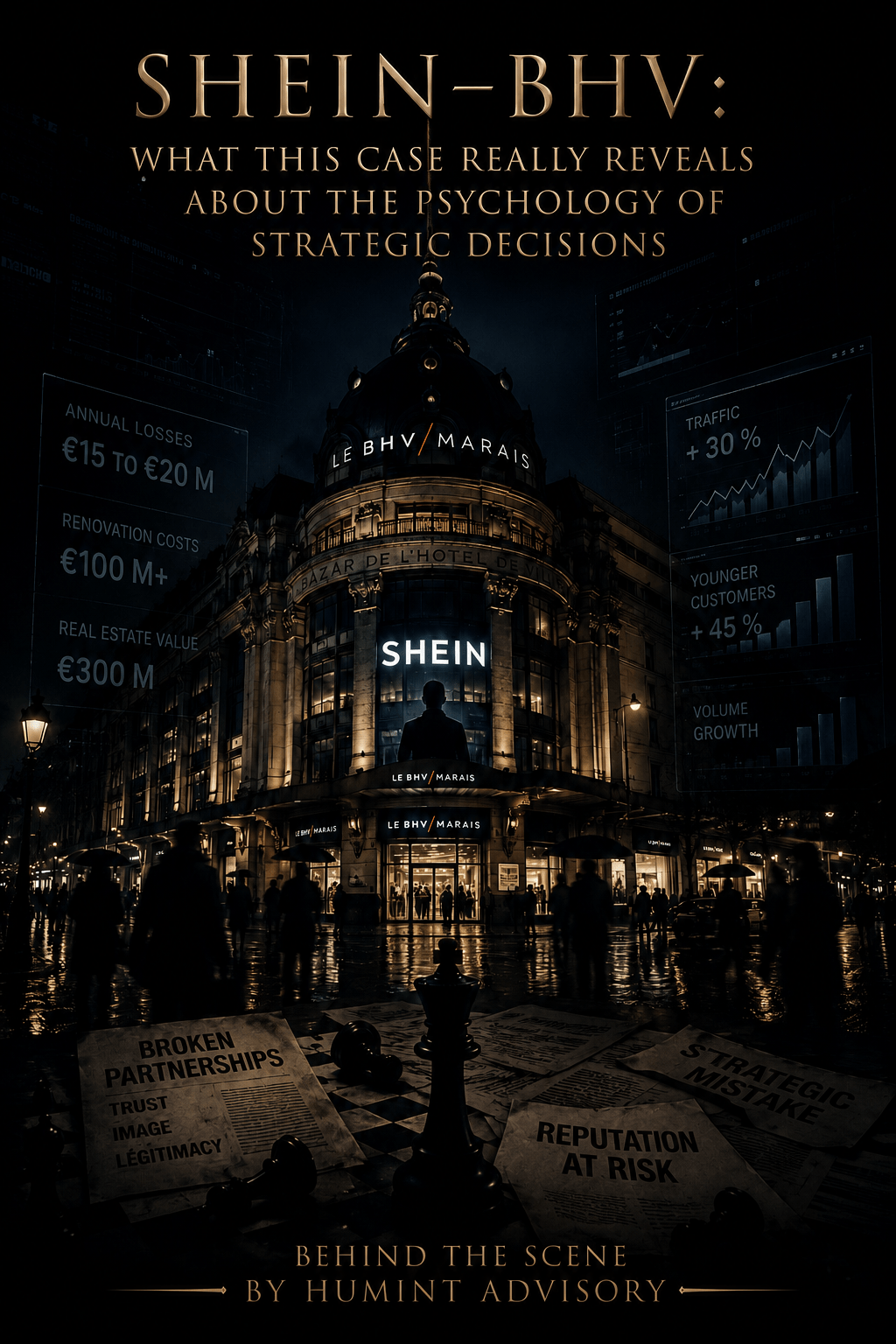
BHV Marais was already losing between €15 and €20 million a year.
More than €100 million in renovation work was underway.
The real estate value of the building was approaching €300 million.
And in a struggling brick-and-mortar environment, traffic had become an obsession.
Against that backdrop, SHEIN offered a simple promise:
more visitors,
younger customers,
higher volumes,
more cash.
In other words:
a survival decision.
Then, only months later, that same decision became a liability.
Brands started distancing themselves.
Financial partners grew uneasy.
Suppliers became nervous.
The ecosystem weakened.
And the new leadership eventually described the partnership as a “strategic mistake.”
How can a decision once considered sound suddenly become indefensible?
Because most crises are not financial first.
They are behavioral.
SHEIN was never the real issue.
SHEIN was merely the catalyst.
When organizations come under pressure, the psychology of decision-makers changes.
Initially, the brain favors immediate gains:
traffic,
volume,
growth.
But when trust begins to crack, another fear emerges:
the fear of losing legitimacy.
Because BHV is not just a department store.
It is a Parisian institution with more than 160 years of history.
And symbols operate under different rules.
They live on consistency.
On memory.
On trust.
On perception.
A brand can survive losses.
It struggles far more to survive a fracture in its narrative.
That is what makes this case so fascinating.
Bringing SHEIN in was probably not irrational.
Ending the partnership probably isn’t either.
Both decisions can be rational.
But they answer two very different fears.
The first:
“How do we avoid economic death?”
The second:
“How do we avoid permanently losing trust?”
Jaguar and Burberry have experienced similar turning points.
In each case, the issue was not managerial irrationality.
It was the gradual change in the nature of risk itself.
Because leaders never manage numbers alone.
They manage perceptions.
And when suppliers, employees, customers, partners and investors begin sending conflicting signals, decisions stop being purely economic.
They become political.
Then emotional.
That is where spreadsheets reach their limits.
Financial statements explain what happened.
They rarely explain why perfectly rational people make decisions that appear contradictory.
Human intelligence is about understanding what comes before the numbers:
fear,
invisible trade-offs,
shifting perceptions,
and that critical moment when a decision suddenly becomes impossible to defend.
Because behind every CEO’s or investor’s decision lies a far more human question:
“What now represents the greater risk: staying the course… or walking away?”
And it is often at that precise moment that the most important strategic turning points occur.
#HumintAdvisory


Votre commentaire