Fifteen days.
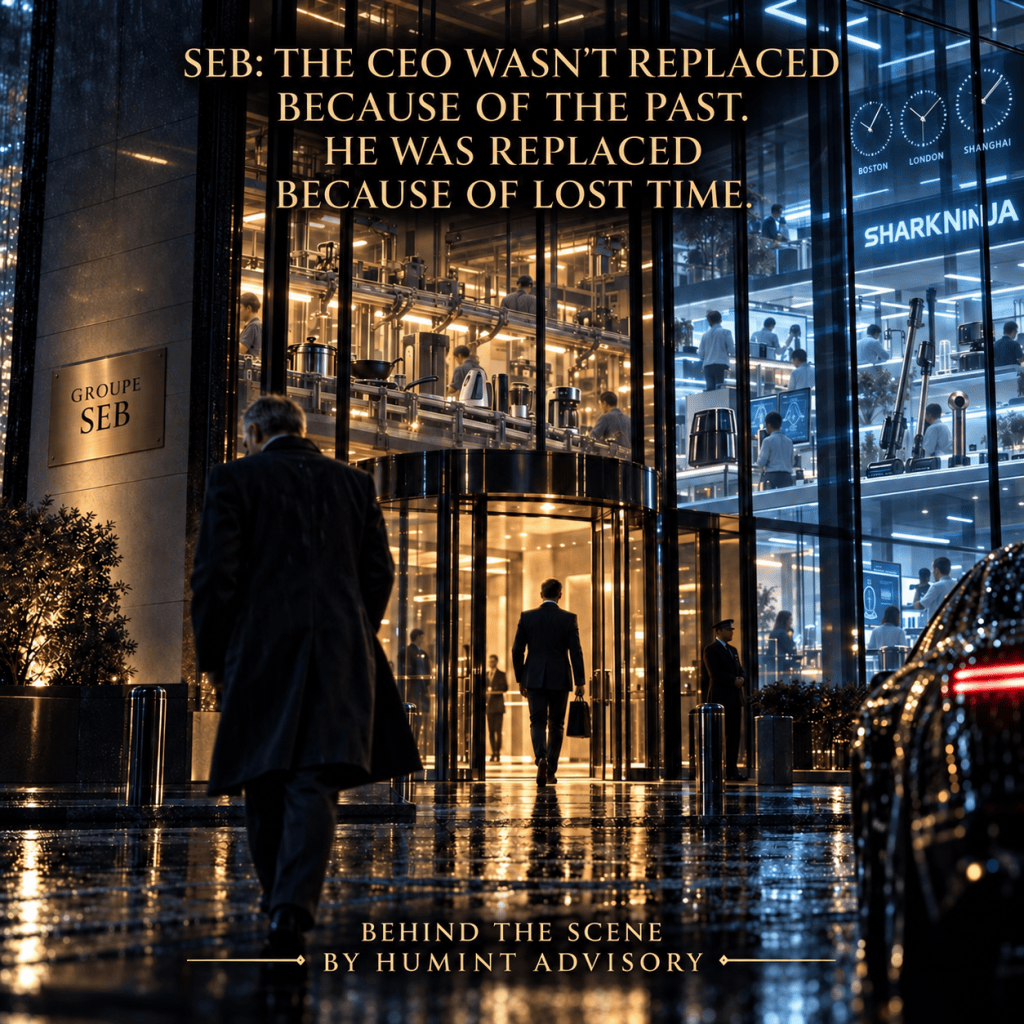
That is the gap between the announcement that Stanislas de Gramont would be replaced and Loïc Moutault taking over as CEO of Groupe SEB.
At this level, speed is a message.
Officially, the Rebound plan remains in place, while operating profit rose 44% in the first half of 2026.
Its leader is being replaced.
The Board is not merely passing judgment on yesterday. It is deciding who can win tomorrow.
Behind that decision stands a threat: SharkNinja.
SEB owns more than 40 factories, employs 32,000 people and commands century-old brands.
SharkNinja owns no factories.
But it owns time.
More than 1,000 engineers and designers work across the United States, London and China. When one team signs off, another picks up the project.
SharkNinja identifies consumer frustrations, prototypes, adjusts and launches. Its cycle can fall to 30 days, versus 75 to 90.
SEB masters the industrial machine.
SharkNinja masters the speed of information.
This is where the HUMINT reading begins.
The numbers show a recovery.
The announcement reveals a rupture.
Fifteen days of transition. No departure described as voluntary. No statement from the outgoing CEO. No next chapter announced for him. Yet his successor receives the Board’s “full confidence.”
That imbalance is not stylistic.
It suggests that trust had already broken down before the numbers recovered.
The Board is sending the organization a message: the diagnosis still stands, but the pace, the method and the person embodying them are no longer enough.
Because the real gap is behavioral.
Inside a legacy organization, information moves upward, crosses functions, waits for multiple approvals, then moves back down toward execution.
Inside a challenger, it flows between the consumer, the engineer, marketing and the manufacturer.
One protects its model.
The other attacks dead time.
Kodak saw digital coming—it helped invent it. Its business model simply could not accept the disruption.
When SharkNinja grows nearly 16% in 2025 while SEB stands still, the Board no longer sees just another competitor.
It sees a company capable of setting the market’s pace.
The reaction becomes visceral.
Not irrational.
Vital.
That is why the choice of Loïc Moutault makes sense.
SEB is choosing a leader shaped by Mars and Royal Canin, with experience in brands, Asia and complex transformations.
The plan remains.
The driver changes.
A Board can accept a bad year.
What it finds much harder to accept is discovering that its company no longer makes decisions at the speed of its environment.
SEB’s real opponent is not only SharkNinja.
It is the gap between what the organization sees, what it dares to decide and what it can execute.
Legacy companies do not decline because they fail to see the threat.
They decline when their own model prevents them from responding to what they already understand.
#HumintAdvisory
 HUMINT Advisory®
Laisser un commentaire