
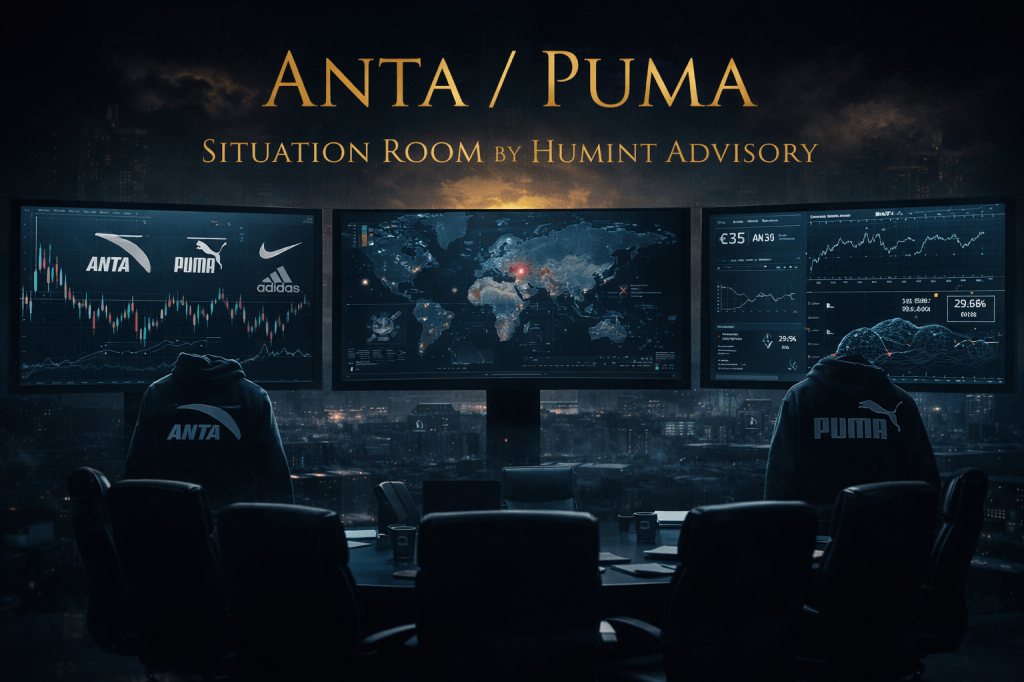
This is not a minority investment.
It is a strategic positioning move in the global competitive arena.
⸻
1. The raw facts (what everyone sees)
Anta Sports acquires a 29.06% stake in Puma, becoming its largest shareholder without launching a takeover bid, at a premium close to 60%.
Conventional economic reading: diversification and an attempt to revive an underperforming asset.
HUMINT reading: securing a strategic lever in an asymmetric competitive conflict.
⸻
2. Anta’s real issue: competitive saturation
Anta is not targeting Puma opportunistically.
Anta is acting out of strategic necessity.
The global sportswear market is now locked by three forces:
• Nike: cultural dominance and global marketing power.
• Adidas: legacy, distribution strength, and European footprint.
• New challengers (Hoka, On, New Balance): rapid growth and innovation-driven narratives.
For Anta, the ceiling is clear:
• Domestic growth under pressure.
• Structural difficulty in turning a Chinese brand into a global icon.
• The risk of remaining a regional champion.
⸻
3. Why Puma, and not another brand
Puma is neither a market leader nor a fallen brand.
That is precisely why it is an ideal target:
• A still-credible global brand.
• Relative weakness versus Nike and Adidas.
• Governance open to a strategic partner.
• Deep historical roots in Europe and Western markets.
Puma is a projection asset, not a domination asset.
⸻
4. The real competitive logic
This transaction allows Anta to:
• Bypass the cultural ceiling faced by Chinese brands internationally.
• Access Western markets without frontal confrontation.
• Test product, retail, and brand strategies at scale.
• Learn directly from proximity to global market leaders.
The objective is not to defeat Nike today, but to shift strategic category.
⸻
5. The 29.06% threshold: neutralising competition without triggering war
This threshold allows Anta to:
• Influence Puma without provoking internal rejection.
• Reassure European partners.
• Avoid immediate competitive mobilisation.
• Stay below political and media radar.
It is a defensive-offensive positioning move, typical of bloc-based competition.
⸻
6. The real battlefield: the invisible war against Nike and Adidas
Anta is not seeking to win short-term market share battles.
It is seeking to:
• Understand the real drivers of Western dominance.
• Embed itself in global decision-making circuits.
• Build a full-scale competitive laboratory.
• Develop indirect global influence capabilities.
⸻
7. Strategic impacts
Short term: Puma stabilisation and narrative repositioning.
Medium term: increased pressure on Adidas in Europe and subtle value-chain rebalancing.
Long term: the emergence of a hybrid Sino-Western bloc challenging historical leaders.
⸻
Conclusion
This positioning is not a response to Puma.
It is a response to Nike, Adidas, and the new challengers.
Anta is not buying a brand.
It is buying a seat in the global competitive war.
Those analysing this move as a simple investment are still looking at the surface.
The real issue is systemic.
⸻
#humintadvisory #situationroom #competition #decisionmaking #influence


Votre commentaire