
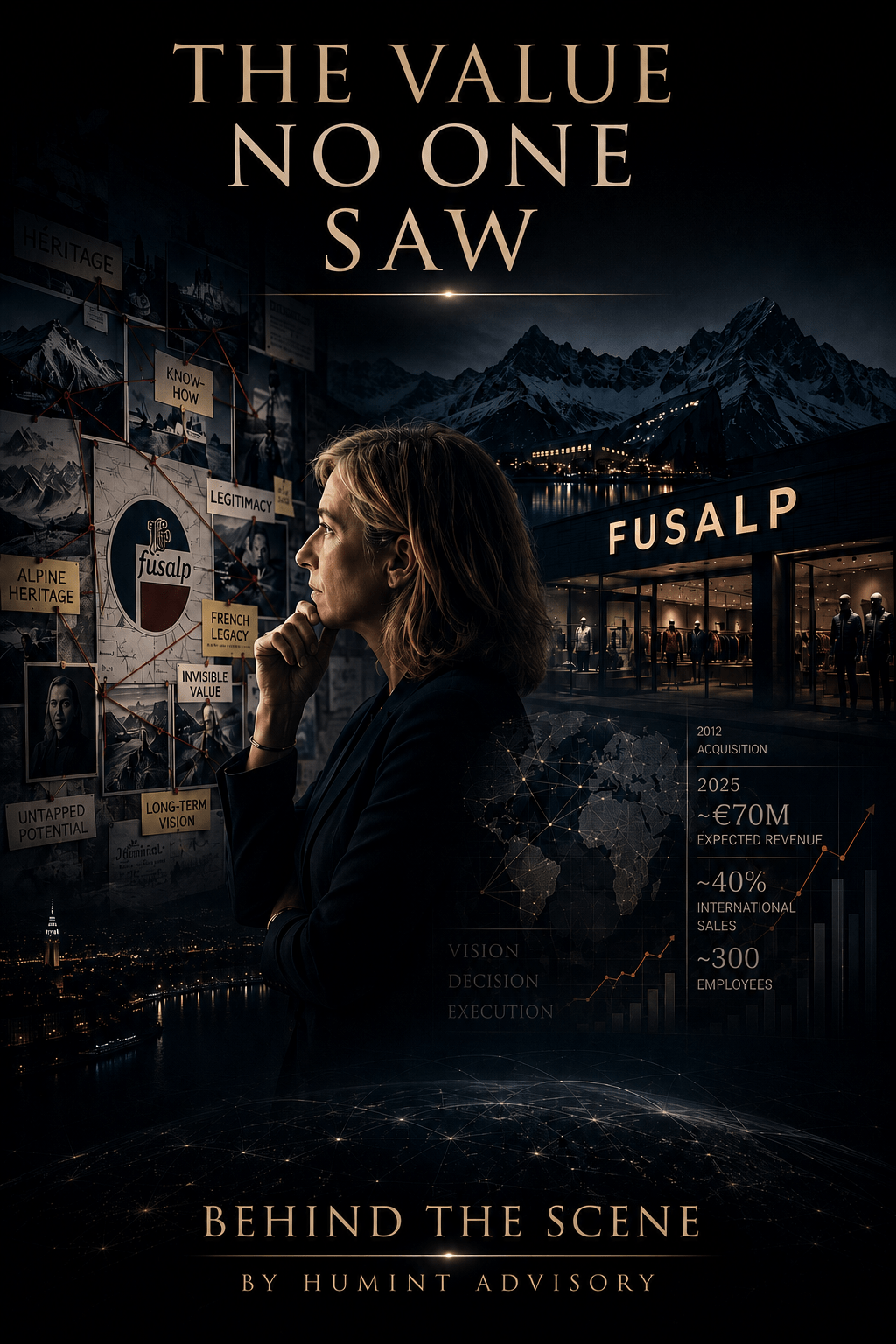
This is a story about interpretation.
When Sophie Lacoste took over Fusalp following the sale of the Lacoste Group in 2012, she did not acquire a fast-growing company.
She acquired a hypothesis.
Thirteen years later:
→ Revenue multiplied by 10
→ Nearly €70 million expected in 2025
→ Close to 40% of sales generated internationally
→ Nearly 300 employees
Business media typically explain this kind of success through product, positioning, or execution.
Yet in most cases, value creation begins long before the first strategic plan.
It begins the moment someone sees what others no longer see.
That is precisely what separates certain decision-makers.
A conventional executive sees an asset.
A builder sees potential.
The first looks for proof.
The second looks for signals.
Moncler under Remo Ruffini.
Brunello Cucinelli in Italy.
Hermès after the 1990s.
Different companies.
Same pattern.
Same mechanism.
None of them invested in a situation.
They invested in a trajectory.
What makes the Sophie Lacoste case particularly interesting lies elsewhere.
Her profile is not that of the classic conqueror.
Nor the financier.
Nor the turnaround specialist.
Instead, her behavior reveals three characteristics that are rarely found together.
First: a long-term orientation.
Thirteen years of development in an environment shaped by weather conditions, consumer cycles, tourism, and luxury market trends.
Very few investors accept that timeframe.
Second: a low dependency on ego.
The project was never built around her personal visibility.
The story remained centered on the brand.
This is often an underestimated signal.
Leaders who build lasting value generally focus on strengthening the asset.
Not themselves.
Third: an ability to identify invisible value.
Most observers saw a ski brand.
She appears to have seen something else:
An Alpine heritage.
French legitimacy.
Technical expertise.
A cultural narrative.
Latent desirability.
In other words:
Assets that cannot be properly valued in a spreadsheet.
This is where the difference between information and intelligence begins.
Between data and interpretation.
Between analysis and decoding.
In the most sensitive strategic situations, the best decisions rarely emerge from having better information.
They emerge from having a better reading of reality.
The ability to identify what remains invisible to the market.
To understand a dynamic before it becomes obvious.
To detect energy before it produces results.
Because ultimately, the question is not why Fusalp is worth more today.
The real question is:
What did Sophie Lacoste see in 2012 that most market participants failed to understand?
Value creation often begins with an act of intellectual disobedience.
#HumintAdvisory


Votre commentaire