That is probably what is unfolding at AT&T right now.
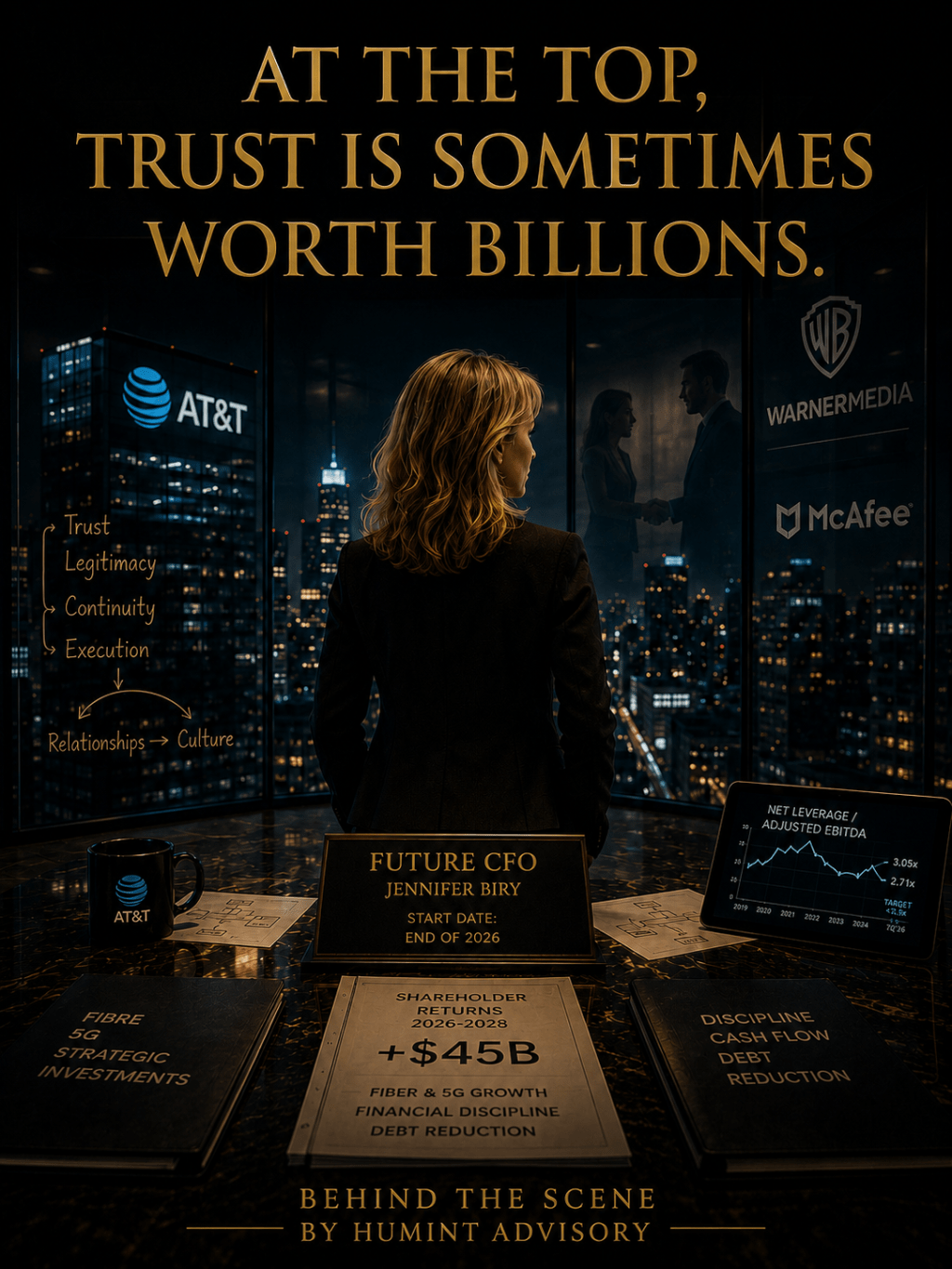
At first glance, the appointment of Jennifer Biry as future CFO and the planned retirement of Pascal Desroches at the end of 2026 look like a textbook succession.
But this is not really a story about finance.
It is a story about risk.
Because AT&T is not operating under ordinary circumstances.
The company generates more than $125 billion in revenue, continues to invest heavily in fiber and 5G, has committed to returning more than $45 billion to shareholders between 2026 and 2028, while still carrying the legacy of years of restructuring and a debt burden that remains among the highest in the industry.
Against competitors such as Verizon and T-Mobile, execution risk is no longer an option.
In this environment, the CFO’s role goes far beyond the numbers.
It is about maintaining market confidence, funding growth, continuing deleveraging efforts, and balancing interests that are sometimes at odds with one another.
In other words, delivering on multiple promises simultaneously.
That is probably why AT&T chose continuity over disruption.
Jennifer Biry already knows the organization.
A former executive at WarnerMedia and later CFO and COO of McAfee, she understands the informal networks, the human dynamics, and the deeper culture of the company.
And during periods of major transformation, that knowledge can be worth more than an impressive résumé.
The comparison with L’Oréal is an interesting one.
Jean-Paul Agon spent years preparing Nicolas Hieronimus’ succession.
The objective was not to surprise.
The objective was to reduce risk.
Because major successions are not talent competitions.
They are exercises in stabilization.
Recent history has shown that markets often punish a loss of confidence in execution more severely than bad news itself.
Perhaps the more interesting question lies elsewhere.
Does this appointment reduce execution risk?
Or does it reflect the board’s belief that, in times of uncertainty, continuity carries greater value than strategic disruption?
The most experienced boards do not always look for the most brilliant leader.
They look for someone who can be accepted by markets, employees, shareholders, and the informal centers of power.
Because at the highest levels, a failed succession can destroy billions in value.
And because in governance, trust remains one of the most difficult assets to rebuild.
For our own C-suite succession plans, perhaps the question is not:
“Who is the best?”
But rather:
“Who will people follow when things get difficult?”
#HumintAdvisory


Votre commentaire