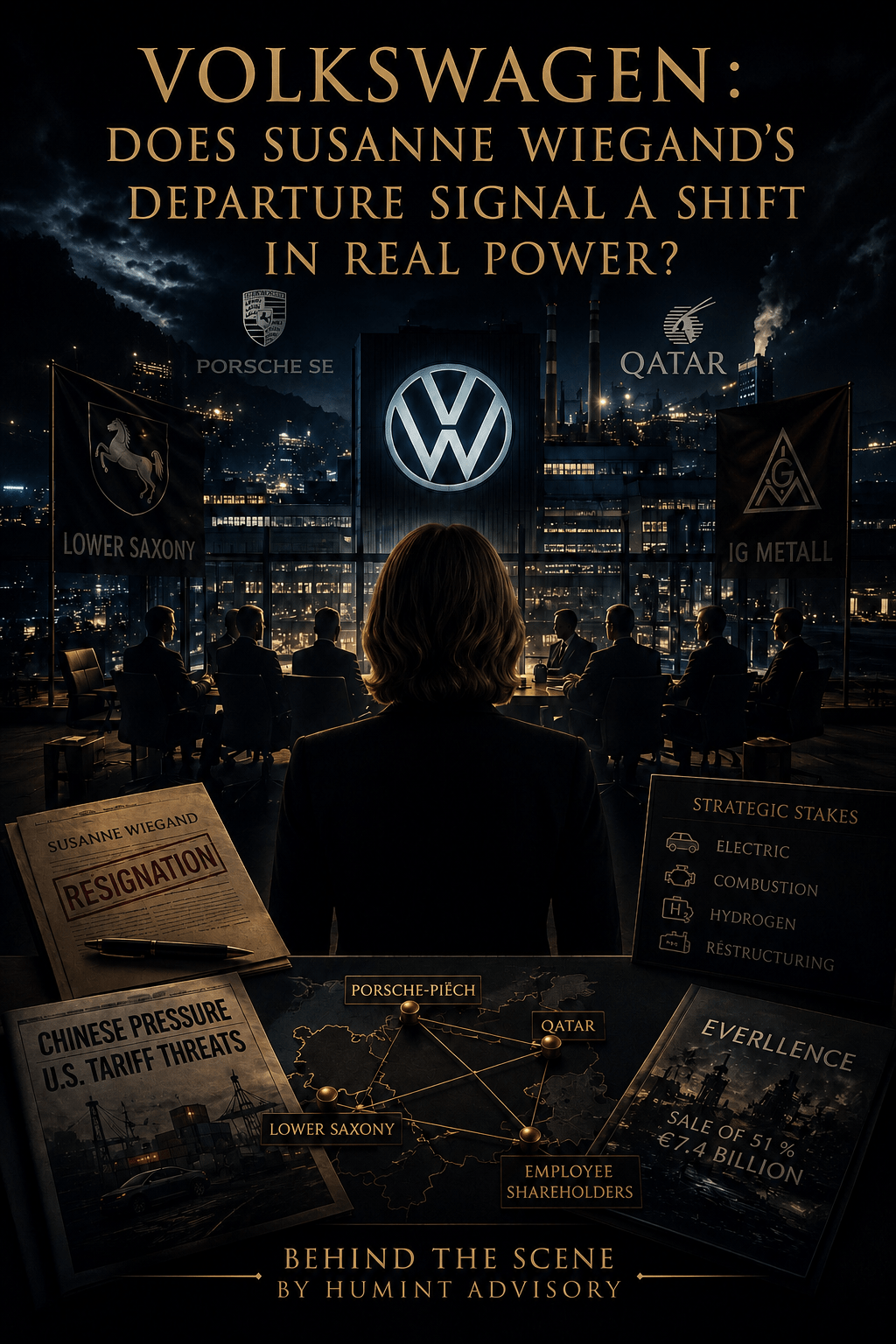
Susanne Wiegand’s resignation from Volkswagen’s Supervisory Board is more than a governance change. It comes at a time when the Group is simultaneously facing unprecedented pressure from Chinese competitors, potentially costly U.S. tariffs, major industrial restructuring programs, and highly sensitive decisions involving its strategic assets.
In this context, the departure of one of the board’s most genuinely independent voices deserves a closer examination.
Because at Volkswagen, the question is never simply: who is leaving?
The real question is: whose relative influence increases as a result of that departure?
Volkswagen’s governance structure rests on a uniquely complex balance of power between the Porsche-Piëch family (through Porsche SE), the State of Lower Saxony, employee representatives, and Qatar. This equilibrium works as long as strategic interests remain aligned. When external pressures intensify, however, historical centers of power tend to consolidate rather than weaken.
The timing raises important questions.
Volkswagen must simultaneously:
• manage accelerating Chinese competition in electric vehicles;
• arbitrate investments across EVs, combustion engines, and emerging technologies;
• execute politically sensitive industrial restructuring plans;
• oversee strategic transactions in which existing governance stakeholders may also emerge as partners or potential investors.
The strategic issue therefore becomes less about the formal independence of board members and more about their actual ability to influence critical decisions.
One indicator always deserves particular attention: the departure of individuals capable of introducing friction into the decision-making process.
The closest historical parallel is probably Renault-Nissan before 2018.
On paper, the Alliance’s governance structure appeared robust. In practice, however, the real centers of power had gradually shifted toward informal networks, political balances, and competing loyalties. When the Ghosn crisis erupted, markets discovered that actual power no longer resided where organizational charts suggested it did.
At Volkswagen, it would be premature to speak of a governance crisis.
However, the departure of an independent voice at a moment when industrial, geopolitical, and shareholder tensions are reaching unprecedented levels constitutes a signal that would be unwise to ignore.
Because in complex organizations, when counterweights weaken, power itself rarely disappears.
What usually expands instead is informal power.
#HumintAdvisory


Votre commentaire