Why His Succession Matters More Than His Results
By Marc Imperiali – HUMINT Advisory
Some statements are never accidental.
Especially when they come from a leader who, for more than twelve years, has spent his time moving lines that few people even realized were shifting.
At Accor’s Annual General Meeting, Sébastien Bazin announced that his current term would likely be his last.
Most observers interpreted it as a governance announcement.
A transition.
A succession plan.
A matter of timing.
They may be looking at the wrong story.
When a leader who has profoundly transformed a company begins preparing his departure, the real question is never about leaving.
The real question is:
What does he believe he has built?
And perhaps more importantly:
What does he believe must outlive him?
Behind every succession lies a vision of the future.
And sometimes, a silent confession.
⸻
I. The CEO Who Was Never a Hotelier
And, in truth, he never really was.
His mental model has never been that of an operator.
Nor a hotel manager.
Nor a room-and-occupancy executive.
Bazin is a capital allocator.
A systems thinker.
A student of balance and leverage.
A reader of business models.
When he took control of Accor in 2013, the company was still largely defined by its assets.
Value resided in ownership.
Buildings.
Real estate.
Physical infrastructure.
Twelve years later, value has migrated.
The assets remain.
But power has moved elsewhere.
Into brands.
Distribution.
Loyalty ecosystems.
Data.
Experiences.
Customer flows.
The ability to exist before the customer arrives and long after they leave.
The shift has been profound.
And largely invisible.
⸻
II. Accor’s Hidden Pattern
One question keeps resurfacing since Bazin announced his succession.
Must Accor be led by a hotelier?
The question sounds logical.
It may not be.
For a simple reason.
When we look at Accor’s official history, we see a global hospitality champion.
When we look at its real history, we see something different.
Its greatest transformations were initiated by people who looked beyond hospitality.
When Paul Dubrule and Gérard Pélisson founded Novotel in 1967, they were not hoteliers.
They returned from the United States.
They observed the rise of American motels.
They understood that a silent revolution was underway:
Mobility.
Automobiles.
Modern tourism.
Business travel.
They did not reinvent hotels.
They reinvented the answer to a changing human behavior.
Hospitality was never the real story.
The traveler was.
Nearly sixty years later, Bazin repeated the same pattern.
He was not a hotelier either.
Yet he transformed Accor more profoundly than most industry veterans.
Why?
Because he looked at the world before he looked at the sector.
Dubrule and Pélisson saw the mobility revolution.
Bazin saw the revolution of platforms, brands, and experiences.
Which raises a different question.
Perhaps the issue is not whether the next CEO comes from hospitality.
Perhaps the issue is:
Which revolution will they be able to see before everyone else?
⸻
III. Markets Look at Numbers. Bazin Looks at Shifts.
The numbers are impressive.
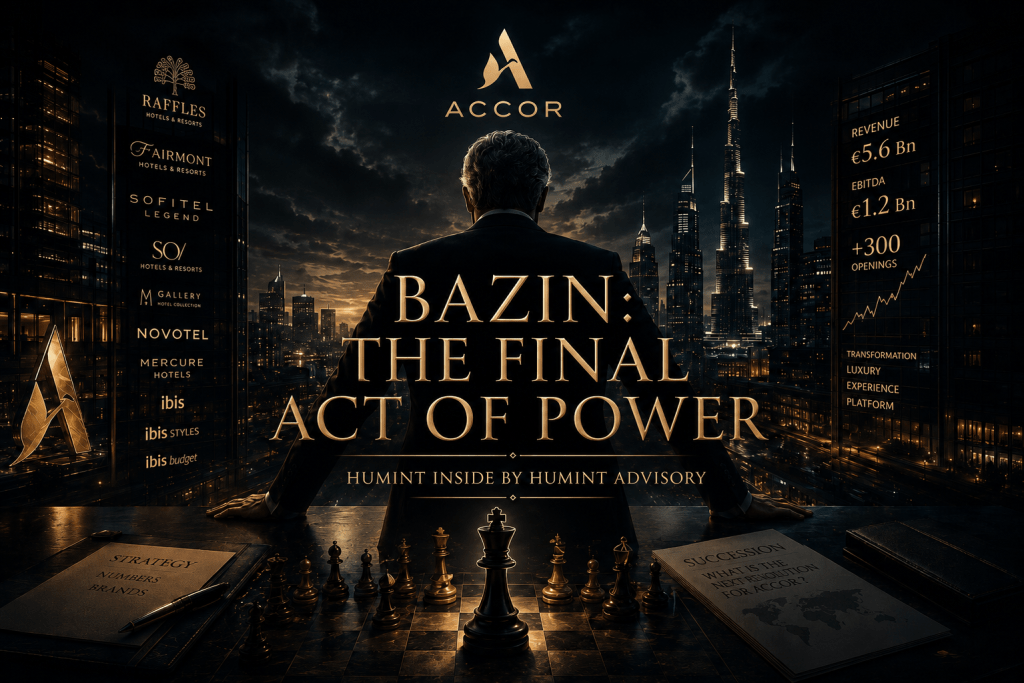
Revenue exceeds €5.6 billion.
EBITDA surpasses €1.2 billion.
More than 300 openings in a single year.
A massive global pipeline.
Yet something remains puzzling.
Accor’s market valuation still does not fully reflect its transformation.
Why?
Because markets like simple categories.
A real estate company.
A hotel company.
A technology company.
A luxury company.
Accor has become harder to classify.
Not fully hospitality.
Not fully platform.
Not fully luxury.
Not fully technology.
Markets often discount what they do not fully understand.
And that is precisely the challenge Accor faces today.
⸻
IV. Behind the Succession: The Recomposition of Power
There is another lens through which this succession should be viewed.
Because Bazin’s succession is not being decided solely in boardrooms.
It is also being shaped in the shareholder base.
And that may explain more than most people realize.
For more than a decade, Bazin benefited from a rare privilege:
Shareholders gave him time.
Time to transform.
Time to reinvent Accor’s value creation model.
Time to build a global luxury platform.
That phase is largely complete.
But the balance of power around the company has evolved.
On one side stand Qatar Investment Authority and Kingdom Holding.
Two shareholders closely tied to the Fairmont, Raffles and Swissôtel acquisition.
Their perspective is long-term.
Strategic.
Global.
They see Accor as an international luxury and influence platform.
On the other side stand international financial investors.
Their question is much more direct:
Why is Accor still valued below what its transformation appears to justify?
This is one of the great paradoxes of the Bazin era.
Operational transformation is widely acknowledged.
Market transformation is not.
Then comes Parvus.
Now the company’s largest shareholder.
And with Parvus comes a different logic.
Not transformation.
Acceleration.
A question every director now hears:
What is the next step in value creation?
That was not the question in 2013.
In 2013, Bazin had to transform Accor.
In 2026, his successor may have to convince investors that this transformation deserves a higher valuation.
Those are different battles.
And perhaps different leaders.
When Bazin says:
“I will leave when the right person is found.”
The HUMINT translation may be:
“I will leave when someone capable of reconciling three different visions of Accor is found.”
The luxury Accor.
The market-facing Accor.
The operating and brand-driven Accor.
Viewed through that lens, succession is no longer about a person.
It becomes a silent negotiation between competing visions of the future.
And that may be where the real battle of the next two years will be fought.
⸻
V. What Hospitality Is Becoming
To understand Bazin’s succession, we must first understand what hospitality itself is becoming.
For decades, hospitality sold rooms.
Then it sold stays.
Today, it is beginning to sell something else.
Care.
Continuity.
Mental ease.
Life simplification.
Experiences.
Look around.
Four Seasons no longer simply sells hotels.
It now sells private-jet journeys around the world aboard its custom Airbus A321neo.
The guest is no longer buying transportation.
Nor accommodation.
They are buying a seamless journey.
A curated reality.
The hotel becomes a stop.
The experience becomes the product.
The same phenomenon can be observed in luxury.
Cheval Blanc.
Belmond.
Ultra-premium hospitality concepts.
The objective is no longer to host.
The objective is to extend an emotional universe.
Identity.
Belonging.
Meaning.
The real product is becoming invisible.
VI. The Battle That Is Just Beginning
This is probably where Bazin’s thinking truly begins.
Accor’s competition is no longer limited to Marriott.
Or Hilton.
Or InterContinental.
Its competitors are now any organizations capable of capturing a customer’s attention, desire, and loyalty over the long term.
Luxury brands.
Platforms.
Communities.
Loyalty ecosystems.
Immersive technologies.
Experience-driven ecosystems.
The playing field is expanding.
And when the playing field changes, leadership profiles change with it.
⸻
VII. The Hypothesis Few Dare to Formulate
What if Accor’s next leader isn’t a hotelier?
Better yet.
What if it’s a woman?
This is not an ideological question.
It is a strategic one.
The transformations awaiting Accor require less hierarchical control.
Less pure operational expertise.
And far more:
- orchestration;
- stakeholder intelligence;
- management of complex coalitions;
- behavioral insight;
- mastery of customer experience.
In other words:
qualities frequently found among leaders who come from luxury, global brands, premium services, or platform-based businesses.
If the next competitive battle is about emotion, experience, and loyalty, then the talent pool extends far beyond the hospitality industry.
⸻
VIII. What Is Probably Going Through Bazin’s Mind
This is where the HUMINT perspective becomes truly interesting.
I do not believe Bazin wakes up asking himself:
“Who can run Accor?”
That question has already been answered.
The teams are in place.
The processes exist.
The brands are established.
The results speak for themselves.
The real question may be:
“Who can move Accor a second time?”
Because that is exactly what he accomplished himself.
Great transformers do not look for a clone.
They look for someone capable of making their own model insufficient.
That distinction is fundamental.
It separates builders from caretakers.
⸻
IX. The Final Act of Power
The most revealing statement Bazin made was probably not:
“I’m leaving.”
It was:
“I will leave when the right person is found.”
That sentence is extraordinarily revealing.
It tells us that he is not thinking in terms of timing.
He is thinking in terms of transmission.
He is not searching for a date.
He is searching for a profile.
A leader.
A vision.
A successor capable of carrying the next strategic shift.
Even while announcing his departure, Bazin continues to shape the framework within which others will make their decisions.
That may well be his final act of power.
⸻
X. What a Succession Really Reveals
Companies often present succession as a question of people.
In reality, it is almost always a question of beliefs.
The chosen successor reveals less about what the Board thinks of the candidate.
It reveals what the Board believes about the future.
Choosing a financial executive sends one message.
Choosing a hotelier sends another.
Choosing a luxury leader sends yet another.
Choosing a technology or experience-driven executive would signal something far more radical.
The future CEO becomes a signal.
Long before becoming a leader.
⸻
XI. The Real Question
The market is trying to determine who will replace Sébastien Bazin.
That is the wrong question.
The question is not:
Who will replace Bazin?
The question is:
What kind of company does he believe he has built?
Because the choice of successor will tell us something far more important than any strategic plan.
It will tell us whether Accor is still a hospitality company.
Or whether it has already become something else.
A global experience platform.
A curator of brands.
A creator of worlds.
A manager of emotions.
A loyalty ecosystem.
Something the market is only beginning to recognize.
⸻
Ordinary leaders pass on a position.
Strategic leaders pass on a company.
The rarest leaders pass on a vision of the future.
Dubrule and Pélisson saw the mobility revolution.
Bazin saw the revolution of brands, platforms, and experiences.
His successor will reveal the next revolution.
And that is precisely why Sébastien Bazin’s succession is not fundamentally a governance issue.
It is a matter of foresight.
Because sometimes, the choice of a successor tells us less about the person who arrives than about the one who leaves.
And about what he believes is emerging beyond the horizon.
The real focus should be on the next shift in the center of gravity.
#HumintAdvisory


Laisser un commentaire