
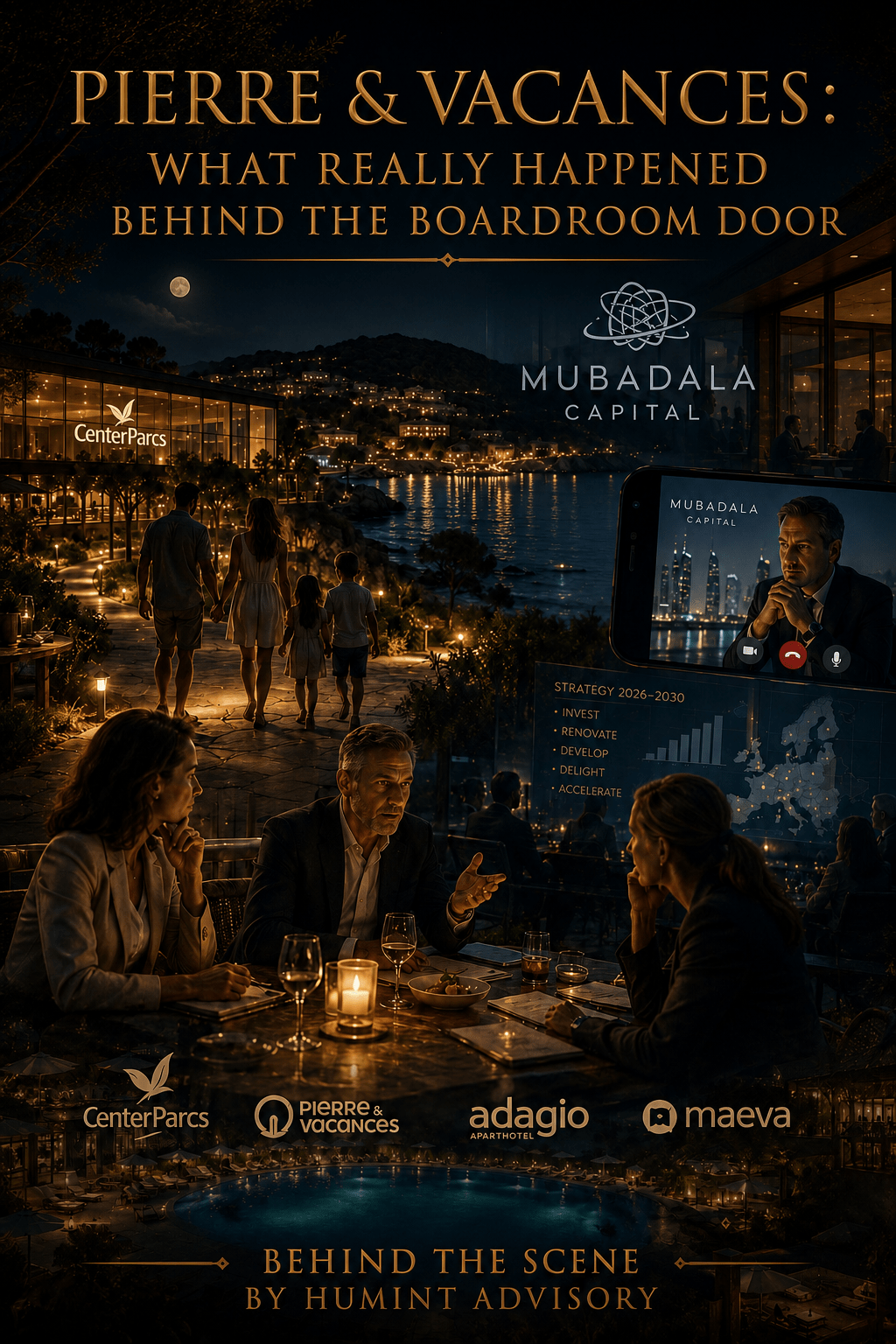
58.9% of the share capital already committed.
A unanimous Board.
Management fully aligned.
An acquisition vehicle ready to take the company private.
When stakeholders with fundamentally different interests move in the same direction this quickly, you’re not looking at just another takeover.
You’re witnessing a carefully orchestrated transfer of power.
Around the table, three agendas emerged.
First, the investment funds that became shareholders during the 2022 restructuring.
They absorbed the highest level of risk: recapitalization, debt-for-equity swaps, deleveraging, and founder dilution. Their business was never to run holiday resorts. Their mandate was simple: stabilize the company, restore value, and exit.
For them, Mubadala isn’t the buyer.
It’s the exit.
Then comes Franck Gervais.
An operator, not a financier. He led the turnaround, refocused the business, and restored performance. His next challenge is turning recovery into sustainable growth.
Mubadala offers what public markets rarely can: patient capital, strategic freedom, and the ability to invest heavily without defending every renovation project every quarter.
At this stage, Mubadala is buying with the CEO, not against him.
But this is precisely where the human equation begins.
Private equity supports leaders only as long as they remain the right leaders for the next chapter. Saving a company requires stability. Accelerating growth often demands portfolio reshaping, asset disposals, organizational change—and sometimes new leadership.
The executive who saves the company isn’t always the one investors choose to maximize its future value.
The third key player is Board Chairman Georges Sampeur.
His role isn’t to emotionally defend a French icon. His responsibility is to deliver a transaction that is legally robust, financially sound, and socially acceptable.
The independent fairness opinion, the special Board committee, and the unanimous vote all point to the same conclusion:
The Board isn’t resisting.
It’s managing a controlled handover.
Why Pierre & Vacances?
Because Mubadala isn’t buying a company in crisis.
It’s buying a company after the crisis.
More than 45,000 accommodations. Around 330 destinations. Nearly 8 million guests annually. Four complementary brands. A business model that would take decades to replicate.
The survival risk has already been priced in.
The upside hasn’t.
Asset upgrades. Customer loyalty. Higher on-site spending. Digital transformation. European expansion. Portfolio optimization.
And above all…
Taking the company private.
That single decision reveals the real strategy.
Mubadala doesn’t just want ownership.
It wants control.
The comparison with Club Med is inevitable.
Fosun acquired a French icon to support a China-focused tourism strategy.
Mubadala is playing a different game: building a resilient European leisure platform designed for long-term value creation.
The real question isn’t whether the brands will remain French.
They probably will.
The real question is this:
Who will decide tomorrow’s investments, tomorrow’s leadership, which destinations expand… and which ones disappear?
Headquarters may remain in Paris.
Power, however, changes address the day the deal is signed.
#HumintAdvisory


Votre commentaire