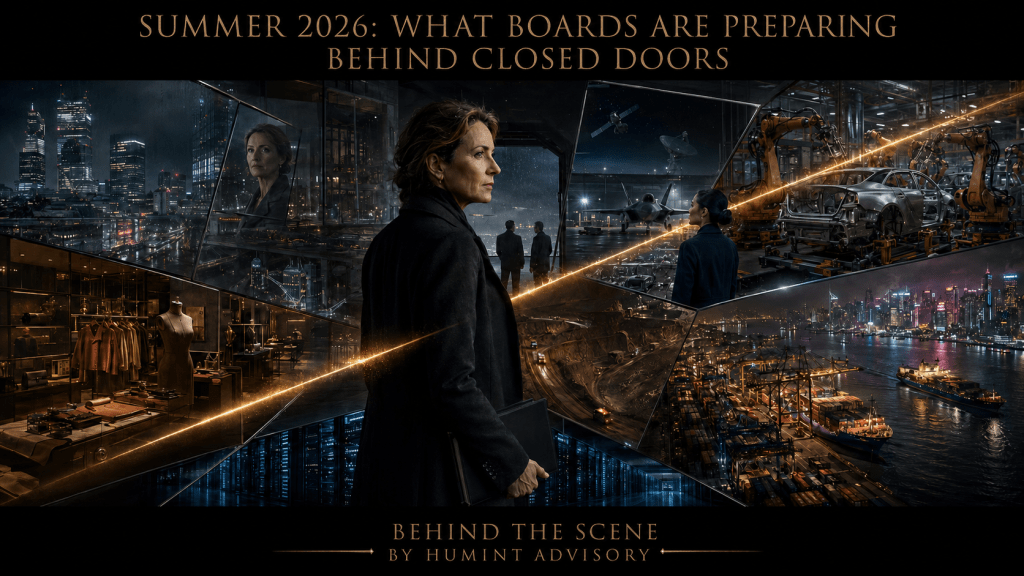
Officially, they are just appointments.
A new CEO at Ipsos. New CFOs at Coty and Julius Baer. New chairs at Burberry, Experian, Icade and JD Sports. Talent, transformation and geopolitical experts joining Barclays, LVMH, Safran and Sopra Steria.
But look beyond the press releases and step inside the boardroom.
Of the ten executive appointments we examined across July and August, nearly eight were external hires. In Q1 2026 alone, 77 new CEOs were reportedly appointed at listed companies worldwide—a record for the period.
This is no longer turnover. It is acceleration.
One phrase keeps appearing: “the right leader for the next phase.”
Those words reveal almost everything.
Boards are no longer searching for the best leader in absolute terms. They are searching for the leader who matches the risk they see coming.
Inside the room, the conversation now sounds more like this:
“If the market turns, can he restructure?”
“Can she challenge the CEO without fracturing the team?”
“Who at this table will say no when every indicator is pushing us to say yes?”
Boards now understand three things.
The honeymoon period is over.
A strategy can become obsolete before a CEO’s term ends.
And a leader who excels in growth mode may be the wrong person when the company must integrate, cut costs, reassure regulators or regain control of the organization.
So the profiles are changing.
Boards increasingly favor stabilizer-transformers: leaders who can reassure markets, decode internal power dynamics and make uncomfortable decisions—quickly.
At Julius Baer, following the Signa losses and amid FINMA scrutiny, hiring a CFO with Standard Chartered and Deutsche Bank experience is not simply about strengthening finance. It means placing someone in the room who can ask:
“Who truly benefits from this decision—and who carries the risk if it fails?”
At Burberry, appointing a former private equity leader as chair introduces greater discipline into the turnaround, capital allocation and CEO oversight.
At Sopra Steria, putting Laura Chaubard in charge of Defense, Security and Space—a business representing 13% of revenue—brings sovereignty directly into execution.
At Safran, appointing an expert in geopolitical and transatlantic affairs acknowledges that risk no longer comes from markets alone. It also comes from governments, technological dependencies and shifting power relationships.
Even the People appointments tell a deeper story.
Barclays emphasizes “transformation,” “performance,” “culture” and board engagement. LVMH speaks of local talent, organizational change and alignment with business priorities.
The People function is no longer support. It is becoming a HUMINT radar: identifying critical talent, preparing succession and detecting who is truly accelerating the strategy—or quietly obstructing it.
That is the real undercurrent.
Boards are becoming more interventionist. They are preparing multiple succession scenarios at once. They are hiring less for the current plan than for the company’s ability to survive the next one.
But there is a risk: by selecting leaders who know how to repair the present, will boards still recognize those capable of inventing what comes next?
Behind every appointment lies one decisive question:
What danger did the board see before everyone else—and whom did it just place in the room to confront it?
#HumintAdvisory


Laisser un commentaire