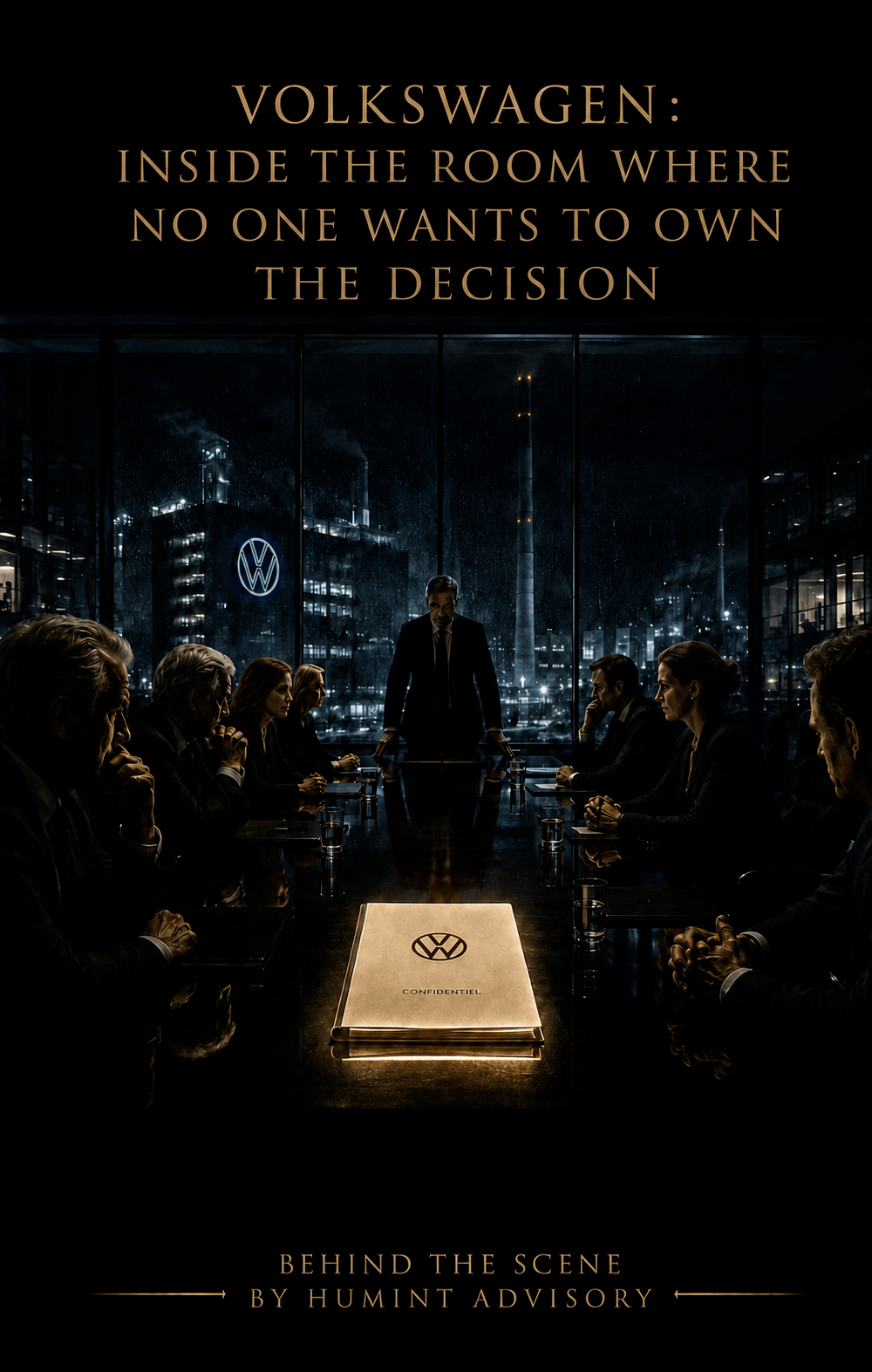
The supervisory boardroom door closes.
Around the table, no one disputes the diagnosis.
Volkswagen is too heavy.
Too slow.
Its European plants are oversized, its costs are too high, and China is moving faster than Volkswagen can decide.
Oliver Blume puts the plan on the table.
Cut capacity.
Cut costs.
Consider the unthinkable: deeper job cuts and the closure of German plants.
Across from him, labor representatives dig in.
Lower Saxony blocks the move.
The decision dies in the room.
Then Porsche SE breaks its silence.
A €2.2 billion loss.
A €3 billion write-down on Volkswagen.
And these words: “historic crossroads,” “every option must be considered,” “strengthen decision-making and execution capabilities.”
This statement is not just about earnings.
It reveals what happened inside the room.
Porsche SE controls 53.3% of the voting rights.
It controls Volkswagen.
Yet it can no longer turn control into action.
Because four power centers are colliding.
The Porsche and Piëch families are protecting their legacy, their wealth, and future dividends.
Employees are defending jobs, factories, and the social compact.
Lower Saxony is protecting its territory and a symbol of German industry.
Oliver Blume must secure a decision tough enough to restore competitiveness—but acceptable enough to be executed.
This is where the HUMINT analysis begins.
Everyone knows Volkswagen must change.
But each player fears the immediate cost of action more than the delayed cost of inaction.
The families will not watch their core asset continue to lose value.
The unions cannot endorse the destruction of what they were elected to protect.
Lower Saxony cannot vote today for plant closures it will have to defend tomorrow.
And Blume cannot lead a plan for long if he cannot get it approved.
The statement is therefore a multi-layered power play.
It publicly gives Blume a mandate.
It forces the opponents of his plan to confront their own responsibility.
And it prepares the narrative for what comes next: if Volkswagen keeps losing ground, the families will be able to say they demanded action.
But that support is also a trap.
Blume wanted a mandate.
Now he is exposed.
He must build a coalition capable of deciding—or become the face of paralysis.
That is what lies beneath the €2.2 billion loss.
The loss is on paper.
The real crisis is human—and rooted in decision-making.
Volkswagen does not lack capital, engineers, or brands.
It lacks someone capable of owning the sacrifice, persuading others to share it, and turning four competing sources of legitimacy into one direction.
In a governance crisis, danger does not begin when no one sees the problem.
It begins when everyone sees it, everyone waits for a decision…
and no one wants to pay the price.
#HumintAdvisory


Votre commentaire