
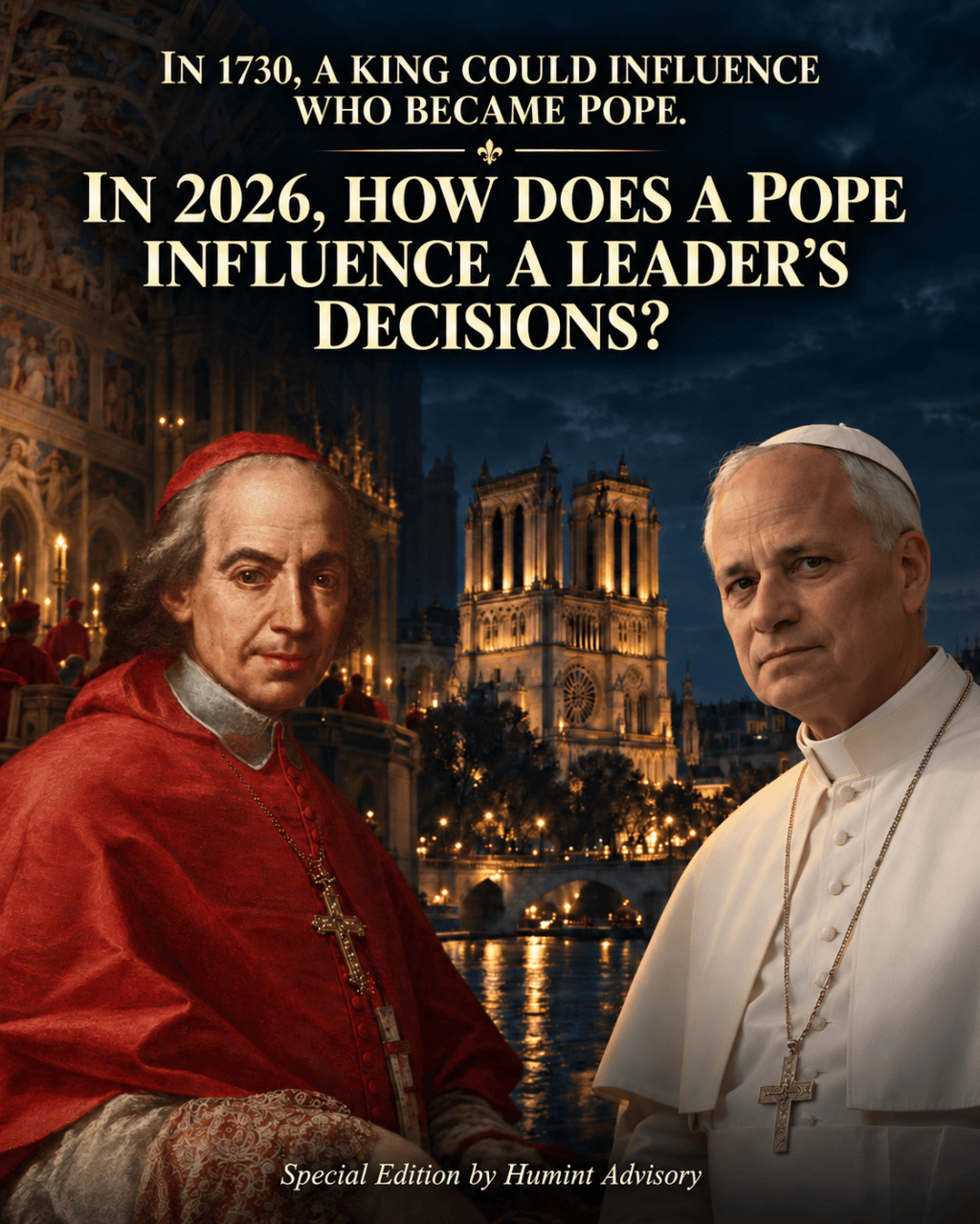
IN 1730, A KING COULD INFLUENCE WHO BECAME POPE.
IN 2026, HOW DOES A POPE INFLUENCE A LEADER’S DECISIONS?
The 1730 conclave holds a singular place in my family’s history. According to our family records, Giuseppe Renato Imperiali was elected pope by a majority of the conclave before the king of Spain intervened. He would never serve as pope.
The episode illustrates a direct form of power: preventing someone from taking office.
Pope Leo XIV, now visiting France, exercises influence of a different kind. He has no veto over legislation. He makes no decisions on behalf of a government. His reach lies in three areas every leader understands: the agenda, the criteria for making decisions, and the decision maker’s credibility.
At the Élysée Palace, he thanks Emmanuel Macron for Notre-Dame. Then he turns to AI, end-of-life care, education, war, and nuclear weapons. He connects issues usually handled separately through a single question: What happens to the human person in the choices we make?
This is no directive to political leaders. It is a question about how they make decisions.
In closing, the pope recalls something Macron told the bishops of France in 2018: a president who disregards the Church and Catholics would be failing in his duty.
It is a reminder that dialogue matters even when positions diverge. It does not imply any change in the president’s policies.
At UNESCO, Leo XIV puts the same question to other decision makers: governments, institutions, scientists, and educators. He does not set their policies. He seeks to influence what they will consider acceptable progress.
For a CEO, the parallel is immediate.
A transformation can be profitable, compliant, and approved by the board. If its human consequences have been underestimated, the risk may surface only afterward: resignations, silent teams, lost trust, slower execution.
The question asked before the vote may matter more than the speech delivered after it.
That is the power a voice like the pope’s can have today: bringing a criterion into the decision-making process that formal authority cannot simply dismiss without considering it.
But that influence has a condition. In Lourdes, the planned meeting with survivors of abuse also requires the Church to answer for its own actions. Credibility does not come with the office. It is proven by how the institution acts.
The Imperiali story shows who could block access to power.
Leo XIV’s visit raises another question, one every leader should ask: Who around you can still reveal what your decision leaves out of view?
#HumintAdvisory


Laisser un commentaire