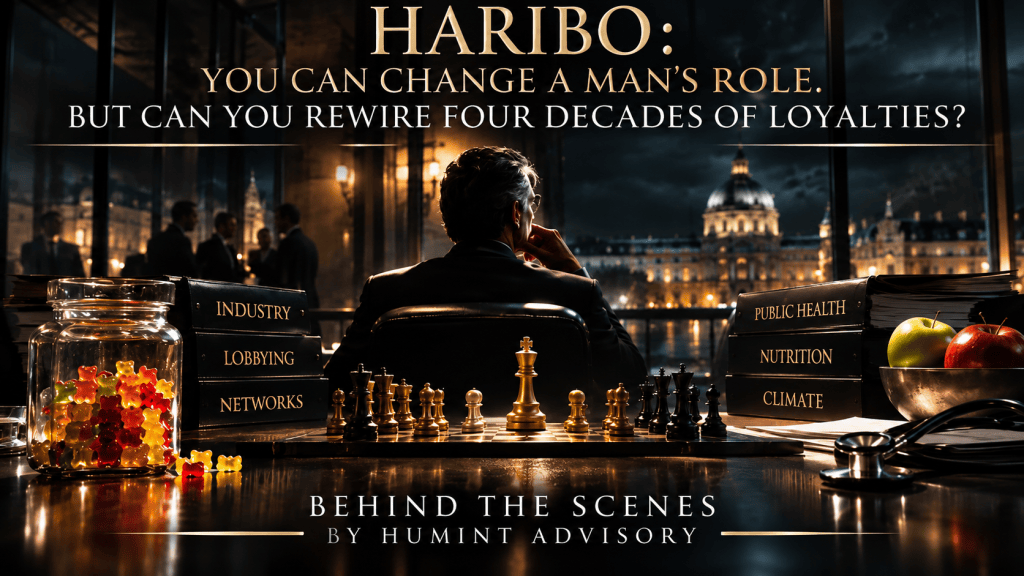
For decades, he defended the interests of the food industry. Today, the French government has entrusted him with helping oversee its national nutrition strategy.
Jean-Philippe André, former Haribo CEO and former chairman of France’s food industry association (ANIA), has become the focal point of public outrage.
Yet reducing this appointment to a clash between sugar and public health misses the bigger picture.
HUMINT ANALYSIS | THE MAN BEHIND THE ROLE
Four decades of leadership, negotiation, advocacy, and institutional relationships do more than build a résumé.
They shape a decision-making architecture.
They influence what we perceive as a threat, an opportunity, an acceptable constraint, or a reasonable compromise.
André’s career reveals a seasoned negotiator, coalition builder, and experienced institutional player.
His strength lies precisely in his understanding of the system.
But how do you assess his ability to distance himself from the very system he helped defend?
This is not a question of morality. It is a question of human behavior.
The most powerful biases are not necessarily those we conceal. They are those we no longer recognize.
THE ILLUSION OF BALANCE
Alongside him stands Mathilde Touvier, an epidemiologist and researcher at Inserm.
Two areas of expertise. Two cultures. Two perceptions of risk.
The government appears to have sought a balance between science and industry.
But bringing two experts together does not necessarily balance their ability to exert influence.
Scientific authority and navigating power dynamics require different skill sets.
In collective decision-making, influence also belongs to those who can steer discussions, build consensus, and reshape the terms of negotiation.
The most subtle form of power is not imposing an answer. It is shaping the way the question is asked.
THE POTENTIAL FLAW LIES UPSTREAM
Who identified this candidate? Based on what criteria? How were his current interests, networks, and behavioral patterns assessed?
Was expertise selected, or was the individual truly assessed against the demands of his future role?
That is the difference between making an appointment and managing governance risk.
Across executive committees, boardrooms, and public institutions, organizations routinely assess what people are capable of doing. Far less attention is paid to what their professional history may predispose them to do.
And that is precisely where decision-making risk can emerge.
The point is not to judge Jean-Philippe André’s intentions, but to examine the strategic intelligence behind his appointment.
HUMINT analysis seeks to understand how an individual’s past could shape their future decisions.
#HUMINTAdvisory #Governance #DecisionIntelligence


Votre commentaire