
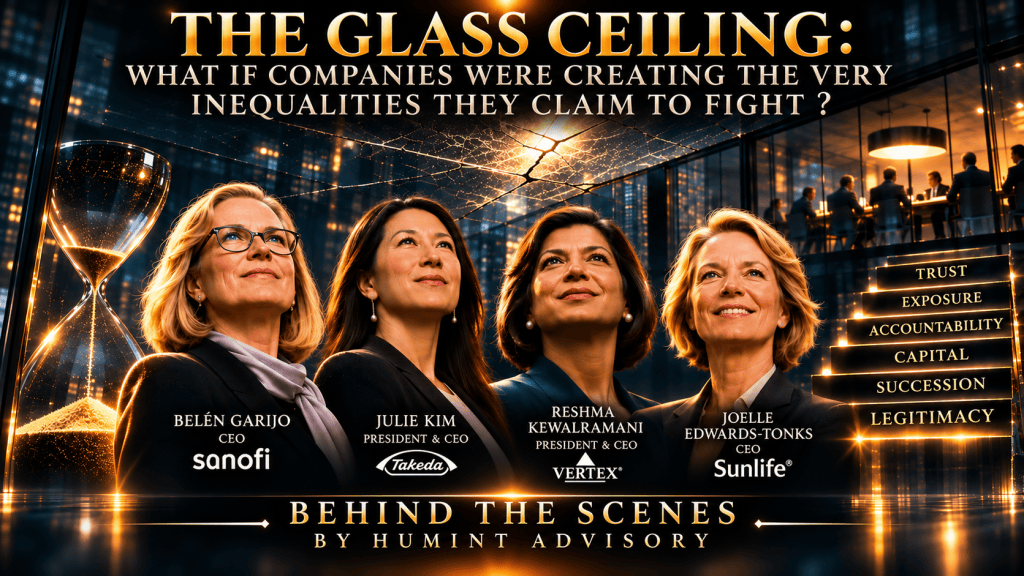
Belén Garijo at Sanofi. Julie Kim at Takeda. Reshma Kewalramani at Vertex. Yvonne Greenstreet at Alnylam. Joelle Edwards-Tonks at Sunlife.
Beyond the rise of women in leadership, these career trajectories reveal something far more significant: a shift in the human mechanisms that determine who gets entrusted with power.
HUMINT ANALYSIS | THE ANATOMY OF A DECISION
In hospitality, women account for 69% of hospitality management graduates and nearly 59% of the workforce, yet hold only around 25% of executive positions.
In UK biotech, just 18.7% of CEOs are women.
Where does the talent disappear?
A board doesn’t simply select competencies. It seeks to reduce human uncertainty: who can be trusted with the company’s future?
Yet the human brain tends to equate familiarity with trust and safety.
That is how organizations replicate their leadership elites, sometimes without any discriminatory intent.
SOME COMPANIES, HOWEVER, ARE REWRITING THE RULES.
Takeda spends years preparing Christophe Weber’s succession, orchestrating an 18-month transition with Julie Kim.
Vertex prepares Reshma Kewalramani for the top job. Alnylam progressively entrusts Yvonne Greenstreet with operations before handing her the reins.
Sunlife follows a similar approach with Joelle Edwards-Tonks.
The common denominator? Building legitimacy before transferring authority.
Sanofi takes a different route: bringing back Belén Garijo, a former Sanofi executive who became CEO of Merck KGaA. Combining insider knowledge with externally established credibility to transform the organization.
In hospitality, Casilda Mulliez at Edgar Suites, Alexandra Goguet at Accor, and Widiane Mendes at HPVA Hotels gain access to three strategic levers: investment, growth, and capital.
Yet men still outnumber women seven to one in hotel investment and development.
POWER IS DISTRIBUTED LONG BEFORE IT IS TRANSFERRED.
Who gets the high-stakes assignments? Who receives informal backing from decision-makers? Whose failures are forgiven? Who gets a second chance?
These micro-decisions shape the candidates that boards will select a decade later.
Here’s the paradox: a perfectly objective appointment can be the end result of ten years of biased decisions.
For a CEO, the real question is not how many women sit on the executive committee, but how many are being given the responsibilities, resources, and trust they need to become the next CEO.
The glass ceiling isn’t just a barrier to power. It’s embedded in the very process that creates it.
#HUMINTAdvisory #Governance #Leadership


Votre commentaire