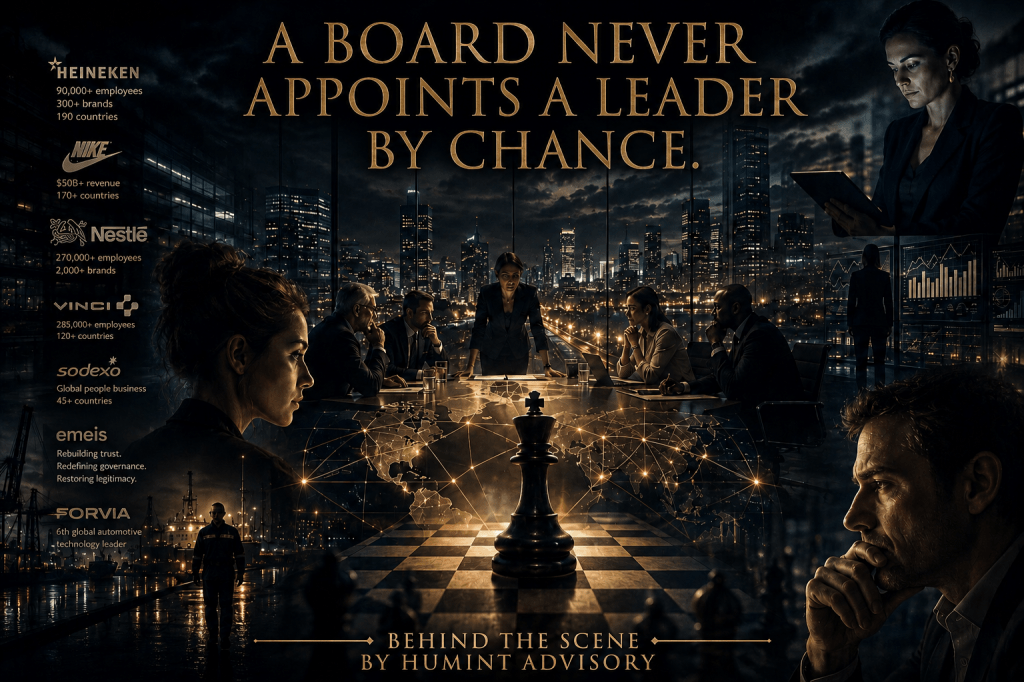
Heineken. Nike. Nestlé. VINCI. emeis. FORVIA.
Different industries.
Different leaders.
Yet every appointment answers the same question.
What risk can our governance no longer afford to carry?
That is where the press release begins.
And where its real value usually ends.
A Board never selects only a CEO, CFO, or Chair.
It selects a way of making decisions.
A way of managing conflict.
A capacity to reassure… or to drive change.
Behavior is what explains why someone gets appointed.
The latest appointments reveal a clear pattern.
Heineken (nearly 90,000 employees, 300+ brands, operations in 190 countries) broke with tradition by appointing an external CEO. The Board accepted cultural risk to accelerate transformation.
By contrast, VINCI (285,000 employees, operations in 120+ countries) promoted an insider. When investment cycles span decades, continuity becomes a strategic advantage.
At Nestlé (270,000 employees, 2,000+ brands), Communications and Sustainability have been brought together under one executive. The message is clear: reputation is no longer a communications issue—it is a governance issue.
At Nike (more than $50 billion in annual revenue), the new CFO is a proven transformation leader. This goes far beyond finance. It is about restoring execution discipline.
As for emeis, following a major restructuring and an unprecedented crisis of confidence, the appointment of its Chair is as much about restoring credibility as it is about governance.
Different decisions.
One underlying logic.
Boards are no longer hiring for expertise alone.
They are appointing leaders who can absorb a specific level of uncertainty.
Another signal deserves attention.
Several executives spent months under observation before their appointments became official.
That period is not administrative.
It allows Boards to assess what no interview can truly measure: the ability to influence without dominating, challenge without dividing, and build consensus without compromising decision-making.
Governance crises rarely stem from a lack of competence.
They emerge when exceptional personalities become incompatible once placed within the same system.
At this level, an organizational chart defines responsibilities.
It says nothing about loyalties.
Nothing about coalitions.
Nothing about the invisible power dynamics that ultimately shape strategic decisions.
An appointment, therefore, is never just an answer to the question:
“Who is the best candidate?”
It answers a far more strategic one.
“Which personality will keep the system stable… when everything around it is becoming increasingly unstable?”
#HumintAdvisory


Votre commentaire